

Table Of Contents
Kinesis Holder’s Yield
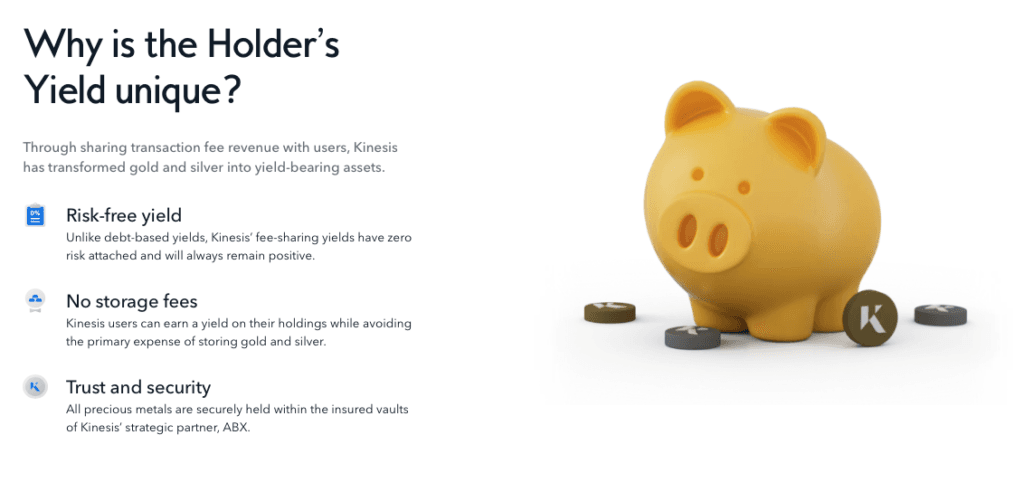
The Holder’s Yield is a feature within the Kinesis Monetary System that distributes a portion of platform fees to users who maintain balances of Kinesis gold (KAU) and Kinesis silver (KAG). These yields are paid monthly in the form of additional KAU and KAG. The underlying physical metals are held in allocated form within insured vaults operated by the Allocated Bullion Exchange, and users do not pay separate storage fees for this arrangement.
“Gold has no yield”
One of the more interesting aspects of the Holder’s Yield is what it does to the nature of precious metals themselves. Traditional precious metals ownership has always involved storage costs and forgone income. “Gold has no yield” is standard terminology in finance and investing. Analysts, economists, and financial journalists routinely describe an investment in physical gold as a non-yielding asset or say that gold bullion has no yield because it does not generate regular interest, dividends, or coupon payments simply by being held.
By combining allocated ownership of precious metals with ongoing distributions, the Holder’s Yield offers one illustration of how gold and silver can function in a contemporary monetary setup.
The Kinesis holder’s yield challenges that dynamic, but it does so without lending out the metals or using them as collateral for leverage. The return comes from transaction fees collected on the platform, not from putting anyone’s bullion at risk. Holders retain full ownership of their allocated metals throughout the process, which distinguishes this arrangement from more conventional forms of yield generation that involve counterparty exposure.
Benefits of the Holder’s Yield for Kinesis Users
Passive Returns on Precious Metals
The most straightforward benefit is that users can receive additional KAU and KAG simply by maintaining existing balances in their accounts. There is no need to trade, stake, or actively manage anything. The yield arrives passively, which means it does not require ongoing attention or decision-making on the part of the account holder. For someone already holding metals within the system, this is essentially an added return that comes without extra effort.
As discussed earlier, participants in the Kinesis Monetary System do not incur the storage fees that are normally associated with owning allocated precious metals. Although the Holder’s Yield itself does not pay these costs, it is worth noting that the same fee-sharing model that funds the Holder’s Yield also covers the storage and insurance costs of the underlying bullion through the Master Fee Pool, allowing KAU and KAG holders to benefit in two ways: they receive a yield on their precious metals while avoiding the storage fees that would ordinarily apply to allocated bullion.
Yield Paid in Precious Metals
The form of the yield is also worth noting. Distributions are made directly in allocated gold and silver, rather than in fiat currency or some other asset. This means that when you receive a payment, it adds to your metal holdings in kind. If you hold gold, you receive more gold; if you hold silver, you receive more silver. Over time, this can compound your position without requiring you to convert between currencies or assets, which some users find simpler and more aligned with their reasons for holding precious metals in the first place.
Long-Term Wealth Preservation
Because yields arrive in physical metal form, they add to holdings that have traditionally been viewed as a way to maintain value over extended periods. Gold and silver do not generate income in the conventional sense, but they have been used for centuries as a store of purchasing power. Adding to those holdings through yield distributions does not change the fundamental nature of the metal—it simply increases the quantity you hold without requiring additional purchases.
Portfolio Diversification
From a portfolio perspective, precious metals often behave differently from equities and fixed-income assets. Their price movements do not always correlate with stock markets or bond yields, which some investors find useful for spreading risk across different market conditions. The Holder’s Yield does not alter that dynamic, but it does add an extra layer to the relationship: you are not only holding an asset with a distinct risk profile, but you are also receiving periodic additions to that holding, which may influence how you think about position sizing or allocation over time.
Ownership of Allocated Bullion
KAU and KAG represent claims on specifically allocated physical bullion, not a general entitlement to a pool of metal or an unbacked promise. This means that when you hold these tokens, there is a direct link to the underlying metal stored in vaults. The yield you receive is likewise allocated metal, not a derivative or a synthetic exposure. For some users, this distinction matters a great deal, as it provides a clearer sense of what is actually owned.
Benefits of the Holder’s Yield for the Kinesis Monetary System
Participation Incentives
Offering returns on holdings can serve as an incentive for users to bring their metals into the system and keep them there: the structure does create a reason for people to consider the platform as an option for storing precious metals.
Interest Alignment
When fees are shared with those who hold balances, there is a direct link between how much activity the system sees and what participants receive, between the platform’s long-term health and the rewards received by users—a relationship that differs fundamentally from debt-based yield models, where returns are typically fixed and the primary concern is the borrower’s ability to meet its obligations.
Long-Term Commitment
Monthly distributions based on balances encourage users to hold their positions rather than move metals frequently. When there is a regular payment tied to the amount you keep in your account, you have an ongoing reason to leave your holdings where they are. This is not a lock-up period or a penalty for withdrawal—you can still access your metals anytime—but the monthly payment adds a small incentive to maintain steady balances, which results in a greater issuance of KAU and KAG.
One might ask what the benefit of that—i.e., of a bigger market cap of KAU and KAG—is, given that the health of the system is determined not by the quantity of KAU and KAG in circulation but by their use. In other words, it depends more on velocity than on market cap. While this is true, a higher market capitalisation can still confer several indirect advantages for the Kinesis Monetary System.
Why a Higher KAU & KAG Market Capitalization Matters
- Improved liquidity and market depth: higher capitalisation is typically associated with tighter spreads and greater capacity to absorb large trades on the exchange. This can make the platform more attractive to bigger users and institutions, which in turn can support higher sustained transaction volumes.
- Signalling and network effects: a larger market capitalisation can serve as a visible indicator of scale and continuity. That visibility may help attract merchants, payment partners, and additional users who prefer systems that already appear well-established, thereby feeding further activity.
- Collateral and partnership considerations: counterparties (card networks, custodians, liquidity providers, regulators) often look at overall market size when assessing operational risk or commercial viability. A higher capitalisation can ease those discussions even if the day-to-day success metric remains transaction velocity.
Inside the Holder’s Yield: Eligibility, Calculation, and Distribution
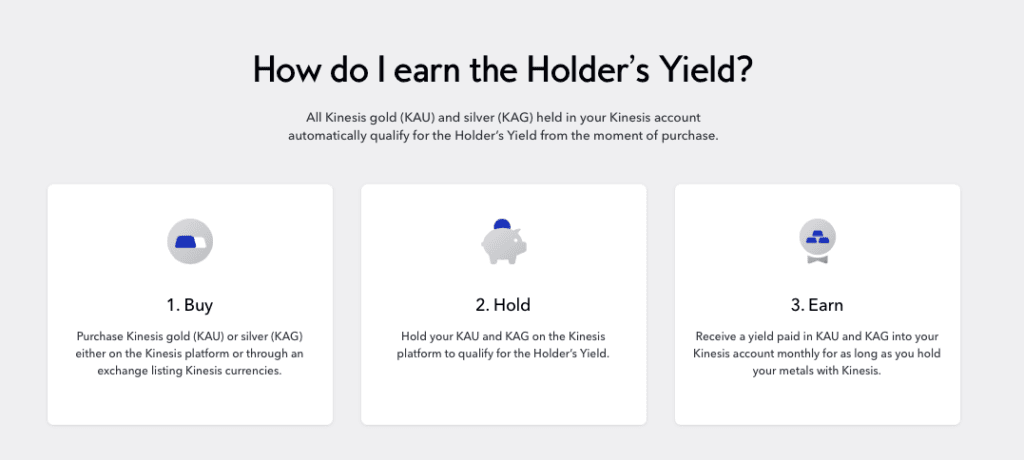
In order to receive the holder’s yield, users simply need to maintain a balance of KAU or KAG within their Kinesis accounts (not outside, like for example in another exchange): only metals that remain inside Kinesis’ ecosystem are considered eligible; if you move your holdings out, they no longer count toward the yield calculation for that period.
Once eligibility is established, the distribution process follows a proportional logic. Each month, the total yield pool—funded from a designated portion of the Master Fee Pool—is divided among all eligible account holders. Your share depends on how much KAU or KAG you hold relative to every other participant in the system. Someone with a larger balance receives a larger slice; someone with a smaller balance receives a correspondingly smaller one. It is not a flat payment, nor is it based on transaction activity or trading frequency—it is purely a function of your holdings as a fraction of the whole.
When the calculation is complete, the system credits the yield directly to your account. If you hold gold, you receive the payout in KAU; if you hold silver, you receive it in KAG. The distribution happens on a monthly cycle, following the platform’s established schedule, and the funds appear in your balance without any action required on your part.
Participation is automatic: you do not need to opt in, stake your tokens, or lock up your metals for a fixed term. As long as the balances remain in your account during the measurement period, the system includes you in the monthly calculation. This removes the need to remember deadlines or manually enroll.