

Table Of Contents
The Referral & Partner Yields: The Reward for Introducing Others to Sound Money
The Referrer’s Yield
The Referrer’s Yield is a feature on the Kinesis Money platform that allows existing users to earn a share of transaction fees generated by people they refer. The yield is paid out monthly in Kinesis gold (KAU) and silver (KAG) and is based on activity from those referred users.
How Does It Work?
When someone signs up for a Kinesis account using another user’s referral link and completes the required KYC verification, the referrer becomes eligible for the yield. From that point on, the referrer receives a portion of the fees whenever the new user mints Kinesis currencies, carries out trades on the Kinesis Exchange, or makes purchases with their Kinesis debit card. This connection remains in place as long as the referred user stays active on the platform.
What Qualifies For The Referrer’s Yield?
To participate, a user simply shares their personal referral link with others—whether individuals they know or businesses interested in the system. Once those referred users verify their accounts and begin transacting, the referrer automatically receives 7.5% of the transaction fees generated from the referred users’ activity in KAU, KAG, and certain crypto-related spending. The arrangement continues for as long as the referred users remain verified and keep using the platform.
How Rewards Are Calculated
The yield amount each month is calculated from the total transaction fees collected from all of a user’s directly referred participants. This includes fees from activity across both their main Kinesis accounts and any external wallets connected to those accounts. The specific types of activity that contribute include a) transactions made with KAU and KAG using the Kinesis card, b) on-chain or blockchain transfers involving KAU and KAG, c) fees associated with minting KAU and KAG, and d) trading activity on the Kinesis Exchange. The platform aggregates these fees for the month and allocates the referrer’s 7.5% share accordingly.
How Many Transactions Must My Referrals Make?
No minimum transaction volume is required. A referrer earns their share on every qualifying transaction their referred users complete during the month. This covers trades, sends, spending, and other operations involving gold, silver, crypto, or fiat currencies processed through the platform. Even modest activity from referred users can generate some yield, provided the transactions produce fees.
A Single-Layer Affiliate Program
Within the KMS there are two related programs: the standard Referrer’s Yield available to regular verified users and the Partner’s Yield, which was introduced as the Kinesis Partner Program in 2024. Both operate on a flat basis rather than a multi-level structure. This means participants earn only from the people they personally refer, with no additional earnings from further levels of referrals: referrers receive a fixed 7.5% of the transaction fees produced by their direct referrals, there are no commissions from anyone the referrals might bring in themselves. The chain stops at the first level of direct referrals. The program does not require users to build teams or networks to qualify for rewards, and there is no cascading of commissions across multiple tiers.
This flat approach differs from traditional multi-level marketing (MLM) programs multi-level marketing, where earnings often depend on building extensive downlines. Kinesis has described the system as “flat” in its community materials and support documentation. The design appears intended to emphasize actual platform usage—such as trading, sending, and spending—rather than recruitment chains. Rewards are tied directly to real transaction fees generated by economic activity on the platform, without the more complex calculations typical of layered structures. This setup also aligns with regulatory considerations in various jurisdictions that examine multi-tier programs more closely.
The Partner’s Yield: Connecting Audiences with Sound Money
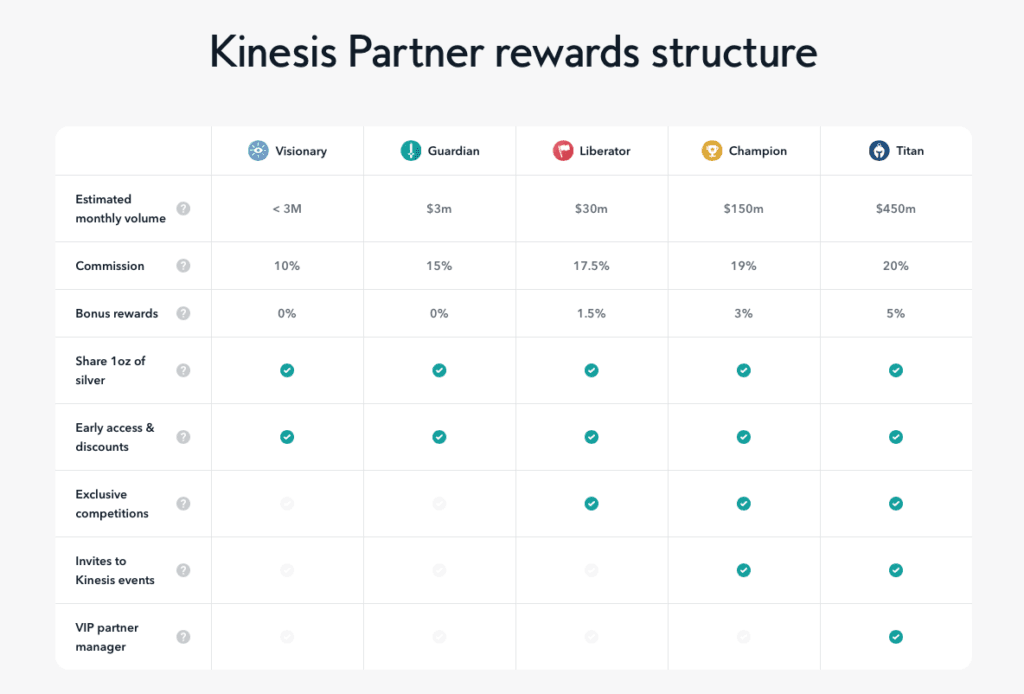
The Kinesis Partner Program is open to individuals and organisations that maintain sizable, engaged audiences capable of generating significant deposit or trading volume on the platform. Accepted partners can receive up to 25 percent of the transaction fees produced by the users they refer. In addition, when the conditions of the Silver Rewards program are satisfied, both standard referrers and partners become eligible for a one-time distribution of 1 KAG (one ounce of silver), which is shared between the referrer or partner and the newly referred user.
A Single-Layer Affiliate Program
The Partner’s Yield follows the same fundamental structure as the Referrer’s Yield, though the potential returns are higher—up to 25 percent of the transaction fees produced by referred users, compared with the standard 7.5 percent. The precise percentage depends on volume milestones, and some partners may also receive access to further benefits such as event invitations or early product features.
Even at this higher level, the arrangement remains strictly single-layer: earnings derive solely from the activity of people the partner has referred directly. There is no provision for receiving commissions on the referrals made by those direct users, and no multi-tier or “downline” structure exists.
At present, both the Referrer’s Yield and the Partner’s Yield continue to function as single-tier programs. Official materials and public statements contain no indication of any plan to introduce multi-layer commissions. The design therefore ties rewards exclusively to the direct introduction of new users and the subsequent activity those users generate on the platform, rather than to the construction of deeper recruitment chains.
Eligibility Requirements for the Partner’s Yield
To become eligible for the Partner’s Yield, a formal application must first be submitted and approved through the official Kinesis Partner Program process. After acceptance, the partner refers users who open accounts and generate transaction fees on the platform. Once those referred users become active, the partner receives a share of the fees produced by their activity.
Key Differences: Partner’s Yield vs. Referrer’s Yield
Both the Partner’s Yield and the standard Referrer’s Yield provide returns based on referrals, yet they differ in scale and structure. Each successful referral that meets the program conditions can qualify for a half-ounce silver bonus, and both arrangements include a share of the transaction fees generated by the referred users. Partners, however, may receive a higher percentage of those fees than standard referrers, and certain additional bonuses or benefits are available only within the Partner Program.
Acting as Both a Referrer and a Kinesis Partner
It is possible to operate as a regular referrer and as a Kinesis Partner at the same time. The Partner Program is aimed at referrers who maintain a substantial audience capable of generating higher volumes of new users. It also suits those who prefer to move their existing referrals into the Partner’s Yield structure. When this transition occurs, the Partner’s Yield replaces the previous Referrer’s Yield for those accounts.
Requisites for Enrolling in the Kinesis Partner Program
Applicants must meet certain audience thresholds or supply a clear explanation of why an exception should be considered. For audiences focused on precious metals the target is more than 10,000 individuals. For audiences focused on payment services the target is more than 5,000 individuals. For audiences focused on crypto trading the target is more than 2,500 individuals. Applicants with smaller but highly engaged audiences may still apply and provide supporting information about engagement levels. The official Partner Program application form must be completed, and evidence of audience size and engagement must be supplied for evaluation. The program is intended for people or organisations whose platforms can generate measurable referral activity.
Monitoring Earnings and Referrals in the Kinesis Partner Program
Partners track their results through a dedicated Partner dashboard that operates independently of the main Kinesis platform. The dashboard displays current commissions and shares of transaction fees. It also allows partners to review the activity and engagement levels of the users they have referred. Additional data such as deposit volumes, transaction statistics, and related analytics are available. This separate software environment keeps partnership activity organised and distinct from standard account functions.