

Table Of Contents
- Vault Audits vs Financial Audits: Verifying Gold and Silver Holdings
Vault Audits vs Financial Audits: Verifying Gold and Silver Holdings
At their core, gold-backed financial products — whether traditional ETFs or newer digital tokens — all rely on one fundamental promise: every unit or share you own is supposed to be backed by a specific amount of actual physical gold sitting in a vault somewhere.
Before physically backed ETFs became popular around 2004, if you wanted exposure to gold you generally had to buy the real coins or bars yourself, arrange secure storage, buy insurance, and handle the logistics. ETFs made the process much more convenient for ordinary investors, but they also meant people had to place more trust in custodians, auditors, and inspection procedures to ensure the gold was really there and properly accounted for.
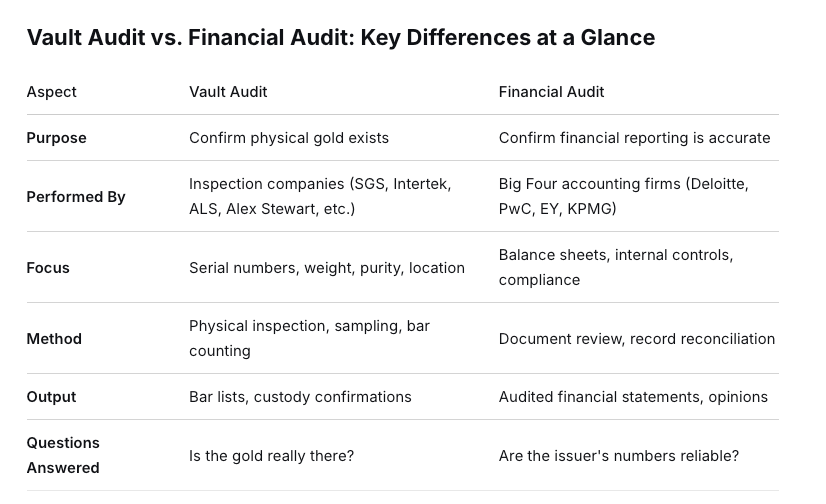
Today, when you invest in something gold-backed, you’re essentially relying on two key claims: a) the physical gold actually exists and is being stored safely, and b) the issuer’s financial records accurately show the assets and liabilities tied to that gold. These are two separate questions, and they require different kinds of verification. That’s why reputable issuers typically arrange for both vault audits and financial audits — each one looks at a different piece of the transparency puzzle.
What Is a Vault Audit?
A vault audit is exactly what it sounds like — a hands-on, physical inspection of the gold sitting in secure storage. The goal is to confirm that the metal actually exists, that the amounts match what’s being reported, and that everything is in proper condition. These audits are typically carried out by companies specialized in commodity inspections like, for example, ALS Global, Alex Stewart International or, particularly for operations in China, Leon Inspection.
Big institutional vault operators — companies such as Brinks, Loomis, and Malca-Amit — run very secure facilities used by central banks, bullion dealers, ETFs, and large investors around the world. They have strict procedures in place: chain-of-custody rules, dual-control access systems, constant surveillance, and detailed inventory tracking. All of this helps reduce risk even before the independent auditors show up for their review.
What Gets Checked During a Typical Vault Audit
- The physical presence and count of the gold bars
- Serial numbers and refiner identification marks
- Weight and purity levels (usually .995 fine or better, in line with LBMA Good Delivery standards)
- How well the physical bars match up with the inventory records
- Confirmation that allocated holdings are properly separated from any unallocated ones
How Vault Audits Are Actually Done
Auditors may do a full count of every bar in some cases, but for very large holdings — and some of the biggest gold ETFs hold thousands of tonnes across multiple locations — that’s often impractical. Instead, they frequently use a combination of random sampling, physical spot-checks, reconciliation of records, and confirmations from the custodian. This approach still gives a high level of assurance without needing to examine every single bar.
What You Get from a Vault Audit
The main deliverable is usually a detailed report or bar list that includes a) the total ounces held, b) serial numbers for individual bars, c) the specific vault location and d) confirmation from the custodian.
One of the better-known examples in the industry is the SPDR Gold Shares (GLD) ETF. They perform a complete bar count once a year and a random sample count the other time. GLD then publishes detailed bar lists that identify each gold bar by serial number, refiner, weight, and purity.
What Is a Financial Audit?
A financial audit is a thorough review of a company’s financial statements to make sure they’re accurate and follow proper accounting standards. These audits are usually conducted according to established frameworks like IFRS or GAAP, and they’re most often carried out by one of the large, well-known accounting firms — commonly referred to as the “Big Four”: Deloitte, PwC, EY, or KPMG.
The modern version of these audits really took shape after the major corporate accounting scandals in the early 2000s, particularly Enron and WorldCom. Those failures highlighted serious problems with internal controls and auditor independence. In response, the United States passed the Sarbanes-Oxley Act of 2002, which strengthened executive accountability, improved internal control requirements, and increased oversight of auditors for public companies.
What Financial Auditors Actually Look At
Financial auditors examine several key areas like balance sheets and income statements, cash flow statements, internal controls and accounting processes or how assets and liabilities are valued and reported.
When it comes to gold-backed products specifically, they focus on things like whether the reported gold holdings line up with what’s on the books, if the liabilities (such as issued shares or tokens) match the assets or whether the company is following proper disclosure rules.
An Important Distinction
Here’s something worth emphasizing: financial auditors generally do not go into the vaults themselves to count or weigh the physical gold bars. Instead, they rely on documentation, confirmations from the custodians, and often the results of the separate vault audits.
This difference is straightforward, but it’s actually quite important: vault audits prove that the physical asset is properly stored, while financial audits prove that a company’s financial statements accurately reflect its financial position.
This separation of duties follows a long-standing principle in professional work: specialists focus on what they’re trained to evaluate. It’s similar to how a property valuation might bring in a structural engineer for technical aspects rather than expecting the accountant to assess the building’s physical integrity. Financial auditors do the same thing when dealing with specialized assets like precious metals, mineral reserves, or other complex holdings — they draw on expert input from the appropriate field.
Why Both Audits Matter for Investors
Gold-backed products really rely on multiple layers of trust to work properly. If you skip the vault audit, you can’t be fully confident that the physical gold backing your investment is actually there. On the other hand, if you skip the financial audit, you might not have a clear picture of whether the issuer’s overall numbers and reporting are reliable.
Most well-established products use both types of reviews together. In a typical setup you’ll see a) a custodian that physically holds the gold, b) independent inspectors who verify what’s actually in the vaults and c) accounting firms that audit the financial statements.
Some of the newer digital platforms take it a step further by adding real-time blockchain tracking or other visibility tools. The overall goal is pretty straightforward: to narrow the trust gap between investors and the people actually holding and managing the gold.
Some Examples from Digital Tokens
Pax Gold (PAXG), issued by Paxos Trust Company, uses monthly financial attestations from KPMG (they previously worked with Withum) alongside annual physical audits performed by Bureau Veritas. Paxos is regulated by the New York State Department of Financial Services, which also has to approve any changes to their attestation providers.
Tether Gold (XAUT) publishes quarterly attestations of its gold reserves. As of March 2026, those reserves had grown to more than 707,747 ounces (worth over $3.3 billion at the time). Their public reporting tends to focus more on these attestations rather than publishing detailed bar-by-bar lists like you see with GLD or PAXG.
Kinesis makes its audit reports available, showing exact circulation numbers. For instance, in October 2025 they reported 2,391,328 KAU tokens in circulation backed by 2,393,328 grams of physical gold — maintaining the 1:1 ratio with a small extra reserve buffer.
Common Misconceptions About Audits of Gold-Backed Products
It’s easy to get confused by the different types of assurance in the precious metals space. You’ll hear terms like “audited,” “attested,” or “reviewed,” and they can sound pretty similar. In reality, they represent different levels of examination and give you different degrees of confidence.
❌ “A financial audit means the gold definitely exists.”
Not necessarily. Financial auditors mainly review paperwork, records, and internal processes. They don’t usually go into the vault to physically verify every bar. For tokens like Tether Gold (XAUT) and Pax Gold (PAXG), issuers often provide attestations or reserve reports rather than full financial audits paired with physical inspections — though both do publish regular updates showing that holdings match circulation.
❌ “A vault audit proves the issuer is financially healthy overall.”
No. A vault audit focuses specifically on the gold inventory. It doesn’t tell you much about the company’s broader balance sheet or overall financial stability.
❌ “Publishing a bar list is the same as a full audit.”
That’s like saying a guest list is proof everyone attended the party. A bar list can be helpful information, but without independent third-party verification, it’s not the same as a proper audit. More credible setups, like what Kinesis does, combine their blockchain circulation figures with independent audit reports so the information is checked by an outside party.
What Investors Should Look For
When you’re evaluating any gold-backed investment, whether it’s a traditional ETF or a newer digital token, there are a few key things worth checking. Here’s a practical list of transparency indicators that can give you a better sense of how solid the setup really is:
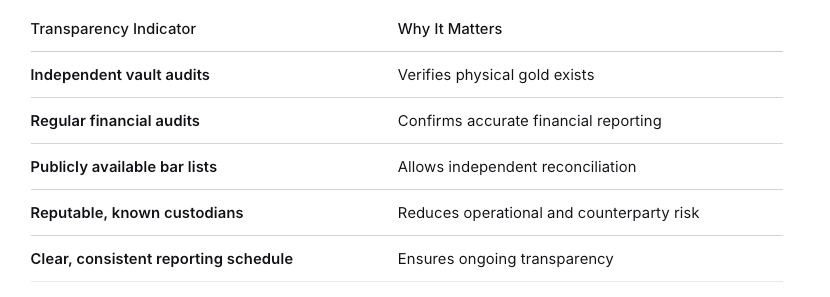
If any of these pieces are missing, vague, or hard to find, that’s often a sign that the overall level of transparency might be lower than ideal.
The more established and credible issuers — whether it’s something like the SPDR Gold Shares (GLD) with its detailed Bureau Veritas bar counts, or digital options like PAXG with monthly KPMG attestations — tend to embrace both types of audits. They understand that layering the physical verification with proper financial oversight gives investors more confidence.
Additional Considerations
Beyond the basic checklist, it’s also helpful to pay attention to a couple of other factors:
- Who is actually performing the audits? Work done by internationally recognized firms with well-established procedures generally carries more weight than reviews from lesser-known organizations that don’t have much of a public track record.
- The custodian’s reputation. The company actually holding the physical bullion matters a lot. Even the best audit is only a snapshot in time, so the ongoing trustworthiness and operational standards of the custodian play a significant role in long-term confidence.