

- Vault Audits vs. Financial Audits in Gold-Backed Financial Instruments: Why Both Matter — and Why They're Not the Same Thing
- Understanding the Difference Between Vault Audits and Financial Audits in Gold-Backed Instruments
- The Trust Problem in Gold-Backed Finance
- Vault Audit vs Financial Audit: Key Differences
- Why Both Audits Matter for Investors
- Common Misconceptions About Gold-Backed Audits
- How Modern Gold Products Combine Both Systems
- What Investors Should Look For
- FAQ: Vault Audits and Financial Audits
Vault Audits vs. Financial Audits in Gold-Backed Financial Instruments: Why Both Matter — and Why They’re Not the Same Thing
Vault audits check whether the physical gold that’s supposed to back things like ETFs, tokens, or certificates actually exists in the vault, in the right quantities, and in good condition. Financial audits, by contrast, look at the numbers side: they make sure the issuer’s financial statements, accounting books, and disclosures are accurate and follow the rules. Put simply:
- Vault audit → confirms the gold is really there
- Financial audit → confirms the financial reporting holds up
For anyone putting money into gold-backed products, these two types of audits play different but equally important roles in building — and maintaining — trust.
Understanding the Difference Between Vault Audits and Financial Audits in Gold-Backed Instruments
Gold-backed financial instruments — whether they’re traditional ETFs or newer digital tokens — all rest on one basic promise: each unit or share you own corresponds to a certain amount of actual physical gold sitting in a vault somewhere. But how do you really know that gold is there? And how do you know the company issuing the product is reporting everything honestly on the financial side? That’s exactly where vault audits and financial audits step in.
People sometimes throw these terms around loosely in brochures or marketing, as if they’re interchangeable. They’re not. They address completely separate parts of the transparency picture, and getting clear on the difference is important if you’re trying to judge how solid a gold-linked investment really is.
The Trust Problem in Gold-Backed Finance
These products live in a strange overlap between physical commodity storage and standard financial reporting. Investors basically have to trust two big claims:
- 1. The gold physically exists and is safely stored.
- 2. The issuer’s financial records properly reflect the assets and liabilities connected to that gold.
Those are two distinct questions, so they need two different kinds of checks. That’s why serious issuers use both:
- Vault audits for the physical side
- Financial audits for the accounting side
Mixing them up can give you a false sense of security.
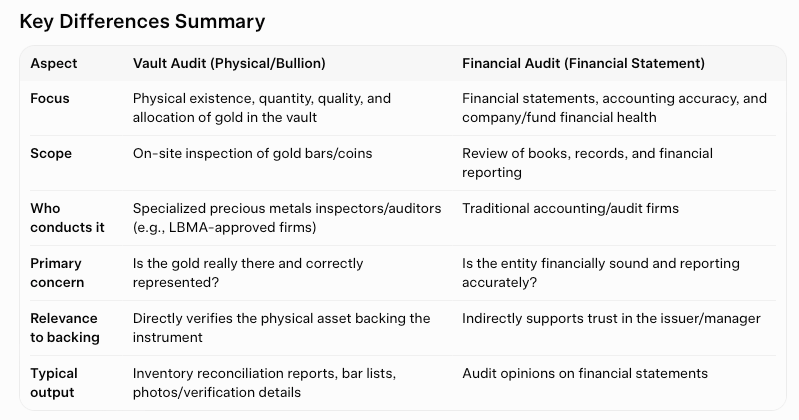
Vault Audit vs Financial Audit: Key Differences
| Aspect | Vault Audit | Financial Audit |
| Primary focus | Physical gold inventory | Financial statements |
| What is verified | Gold bars, weight, purity, serial numbers | Accounting accuracy |
| Who performs it | Inspection firms or vault auditors | Accounting firms |
| Frequency | Monthly, quarterly, or ad hoc | Typically annual |
| Investor value | Confirms the gold exists | Confirms financial transparency |
What Is a Vault Audit?
A vault audit is a hands-on inspection that confirms the physical gold in the secure storage facilities actually exists, matches the reported amounts, and is in proper condition. These are usually done by independent inspection companies or specialized teams — firms like Bureau Veritas, for example.
What gets checked in a typical vault audit:
- – The gold bars themselves
- – Their serial numbers
- – Weight and purity (generally .995 fine or better)
- – Whether the physical bars line up with the inventory records
- – How the holdings are allocated (allocated vs. unallocated)
Auditors often do random samples or, in some cases, count every bar.
The main output is usually a detailed report or bar list that spells out:
- – Total ounces held
- – Serial numbers for each bar
- – Where the vault is located
- – Confirmation from the custodian
Big gold funds frequently publish these bar lists regularly so everyone can see them.
What Is a Financial Audit?
A financial audit is a review of an organization’s financial statements to make sure they’re accurate and comply with accounting rules. It follows established standards like IFRS or GAAP and is typically carried out by one of the big accounting firms — Deloitte, PwC, EY, that level.
Financial auditors dig into:
- – Balance sheets
- – Income statements
- – Cash flow statements
- – Internal controls and accounting processes
- – How assets are valued
For gold-backed products specifically, they check things like:
- – Whether reported gold holdings match the books
- – If liabilities line up with the shares or tokens issued
- – Compliance with disclosure rules
Important point: financial auditors don’t usually go into the vault and weigh bars themselves. They rely on records, custodian confirmations, and often the vault audit reports. The distinction is straightforward but matters a lot:
- Vault audits prove the asset is real.
- Financial audits prove the reporting about it is honest.
Why Both Audits Matter for Investors
Gold-backed products depend on layers of trust. Skip the vault audit, and you can’t be sure the gold backing your investment is actually there. Skip the financial audit, and you can’t trust that the issuer’s numbers are reliable.
Major products use this two-pronged approach. Take:
- – SPDR Gold Shares (GLD)
- – iShares Gold Trust (IAU)
- – Kinesis Money (KAU and KAG)
In these setups:
- – A custodian holds the physical gold.
- – Independent inspectors verify what’s in the vaults.
- – Accounting firms audit the financial statements.
Each piece covers a different angle of transparency.
Common Misconceptions About Gold-Backed Audits
“A financial audit means the gold definitely exists.”
Not always. Financial auditors check paperwork and records; they don’t necessarily verify every physical bar in person. For some gold-backed tokens like Tether Gold (XAU₮) and Pax Gold (PAXG), issuers provide attestations or reserve reports rather than full financial audits combined with physical inspections — though both publish regular reserve confirmations showing holdings match circulation.
“A vault audit proves the issuer is financially healthy overall.”
No. It confirms the gold inventory but says nothing about the broader balance sheet or the company’s financial stability.
“Publishing a bar list is the same as a full audit.”
A bar list is useful documentation, but without independent third-party verification, it’s not the same as a proper audit.
How Modern Gold Products Combine Both Systems
A lot of today’s gold-backed offerings pull everything together:
- – Independent vault inspections
- – Standard financial audits
- – Regular public reporting
Some digital platforms go further with real-time tracking or blockchain layers for extra visibility. The aim is straightforward: close the trust gap between investors and the people holding the gold.
What Investors Should Look For
When you’re sizing up a gold-backed instrument, check if the issuer offers:
- 1. Independent vault audits
- 2. Annual (or regular) financial audits
- 3. Publicly available bar lists
- 4. Reputable, known custodians
- 5. Clear, consistent reporting schedule
If any of those pieces are missing or vague, the level of transparency is probably lower than ideal.
FAQ: Vault Audits and Financial Audits
What is a vault audit?
It’s an independent inspection that verifies the existence, weight, purity, and identification of physical gold bars held in vaults to back financial products.
What is a financial audit?
It’s an independent review of financial statements and accounting records to confirm they give a true picture of the company’s financial position.
Do gold ETFs perform vault audits?
Yes, most major ones — like GLD and IAU — carry out regular vault inspections or inventory checks, usually by independent firms.
Can a financial audit confirm physical gold holdings?
Not directly. It reviews documents and records, but it typically depends on custodian reports and physical inspection results for the actual metal.
Why do investors need both types of audits?
Because vault audits confirm the asset exists, while financial audits confirm the reporting is accurate. You need both for real transparency.