
Table Of Contents
The Gold Standard Of E-Commerce Payments
Kinesis Pay is a payment system that enables businesses to accept allocated precious metals as part of their payment infrastructure. It functions as an add-on that can be installed on existing online store platforms, allowing merchants to receive payments in digital representations of physical gold and silver. Installing the Kinesis Pay tool costs nothing, and neither the shop nor the customer pays a fee to the system for each payment.
Kinesis Pay for Businesses
The system is intended for both sole traders and larger companies. It does not impose size restrictions, so small vendors and multinational firms can both use it.
Setup and Management
Businesses can create their profile from the Merchant section of their Kinesis account. The process does not cost anything and does not require complex configuration. Once the profile is active, merchants can begin accepting KAU and KAG payments on the same day. The dashboard includes tools for viewing and analysing transactions, offering data that can help businesses track performance.
Benefits
- Offering gold and silver-backed digital currencies gives customers an alternative to fiat payments. This may appeal to buyers who prefer asset-backed forms of money.
- Merchants in different countries can accept payments in Kinesis gold (KAU) and Kinesis silver (KAG), which may reduce some of the friction associated with cross-border transactions.
- The installation process carries no additional fees, which lowers the barrier for smaller businesses.
- Accepting precious metal payments aligns with current trends in digital finance, though the actual business impact will vary by sector and customer base.
- Transactions do not rely on bank processing in the same way that card payments do, which may reduce certain processing delays for international transactions.
- Gold and silver have historically held value over long periods, and accepting payments in these metals may provide a buffer against fluctuations in fiat currencies.
- Holding balances in gold and silver also reduces a business’s exposure to any single currency or financial system.
- Holder’s Yield – Merchants who retain their KAU or KAG balances in their account become eligible for a monthly distribution from transaction fees. This is paid based on the amount of metal held.
- Referrer’s Yield – Businesses can refer other merchants or clients to the platform. When a referred client makes a payment, the referring business receives 7.5% of the transaction fees generated from that activity.
Kinesis Pay for Customers
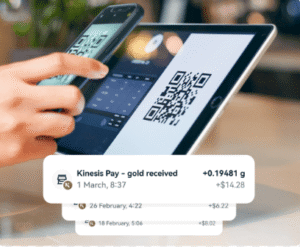
For buyers, Kinesis Pay integrates into the checkout process of participating online stores. The payment method does not require the customer to share card details with the merchant. At checkout, the customer scans a QR code using the Kinesis mobile application. The transaction is then completed directly in gold (KAU) or silver (KAG). No card information is transmitted during the process, and no currency conversion is needed at the customer’s end.
For people who do not yet have a Kinesis account, the system introduces them to the concept of precious metal-backed payments. The main points of appeal are the relative stability and long-term value associated with gold and silver, compared to conventional currencies that can be subject to inflation or exchange rate movements. The checkout process itself is similar in flow to other QR-based payment systems, so the learning curve for new users is relatively shallow.
Wider Payment Context
Online shopping keeps growing. Worldwide online sales have passed 5 trillion dollars in recent yearly counts, and a rising share of those sales already happens through digital methods that are not cards. In some countries mobile wallets and QR systems now handle more than half of all digital shop payments. At the same time, ordinary card networks still charge shops between 1.5 and 3 percent of each sale in many places, and the rate is often higher for sales that cross borders or fall into higher-risk groups.
Against that background, the fact that installing the Kinesis Pay tool costs nothing, and that neither the shop nor the customer pays a fee to the system for each payment, stands out as a differentiator. Whether this translates into meaningful savings for a given business depends on several factors: the volume of transactions processed through the system, the merchant’s existing card processing rates, and the share of customers who actually choose to pay using gold or silver rather than conventional methods. For merchants with high cross-border sales or those operating in sectors where card fees are particularly steep, the absence of per-transaction charges could be relevant. For others, the benefit may be more marginal. In any case, the fee structure—or lack thereof—is one of the clearer, more easily quantifiable benefits of the system, separate from the broader proposition of accepting precious metal-backed digital currencies.