

Table of Contents
Gold-Backed Tokens Compared: Kinesis Gold (KAU) vs. Tether Gold (XAUt) Vs. Pax Gold (PAXG)
Three distinct players have emerged as the leading options for digital gold exposure: Tether Gold (XAUt), Pax Gold (PAXG), and Kinesis Gold (KAU). While XAUt and PAXG dominate the market with their institutional-grade credibility and deep liquidity, KAU offers a unique yield-generating model that sets it apart from the competition. PAXG and XAUt are principally designed as digital vehicles for investing in gold, while Kinesis Gold (KAU) takes a more ambitious approach: it seeks to make gold usable as everyday money. The distinction goes beyond product design. It reflects an old monetary question that has never entirely disappeared: should gold remain a secure store of wealth, held against uncertainty, or should it circulate as a living medium of exchange? This comprehensive comparison breaks down how each token operates, where they differ in regulatory oversight and redemption mechanics, and which one best suits your investment goals in today’s evolving digital asset landscape.
Investment Tools vs. Everyday Currency
Gold tokens are one of the seven ways to invest in or gain exposure to gold, and they are attracting increasing inflows—as evidenced in Q4 2025, when trading volume of tokenized gold surpassed that of five major gold ETFs for the first time. Currently, the tokenized gold market is dominated, by a considerable margin, by the two giants, Pax Gold and Tether Gold.
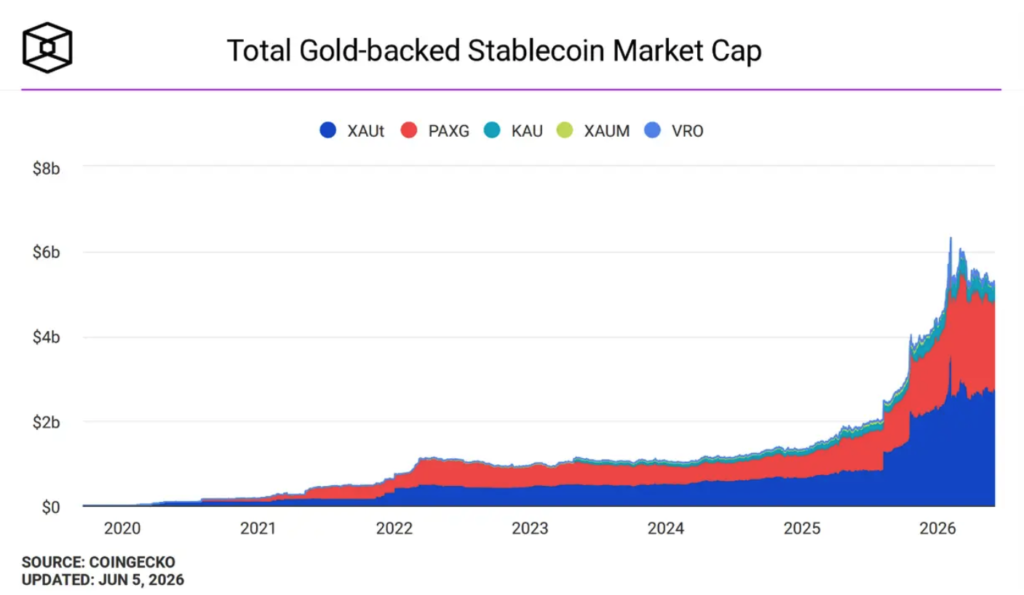
Pax Gold (PAXG), issued by Paxos, represents one troy ounce of LBMA-accredited gold held in professional vaults. As a product of a regulated trust company, it operates within a comparatively rigorous U.S. regulatory framework. Physical redemption is possible, but the process is geared toward larger holdings, with delivery generally tied to specified vault arrangements. Smaller investors are therefore more likely to sell for fiat or retain their exposure digitally. The model is built around secure and compliant ownership of allocated gold, supported by independent attestations and designed for straightforward trading. Its natural role is in portfolio allocation, hedging, and institutional or investment-oriented use.
Tether Gold (XAUt), issued by Tether, follows a broadly similar ounce-for-ounce model, with the underlying gold held in Swiss vaults. Its support across multiple blockchains gives it considerable flexibility within the wider crypto market, while its broad distribution makes it readily accessible to digital-asset traders. Physical redemption is likewise oriented toward larger quantities, with the associated logistics and costs concentrated in Switzerland. XAUt is therefore best understood as an efficient on-chain representation of gold, particularly suited to trading, liquidity management, and participation in decentralized finance rather than routine consumer spending.
KAU begins from a different premise. Each token represents one gram of allocated gold held across a distributed network of vaults. Its redemption structure is designed to be more accessible to individual users, with delivery facilitated through established logistics partners. More importantly, Kinesis has built an ecosystem around practical use: debit-card spending at merchants worldwide, tools for businesses to accept payments, and a fee-sharing mechanism that distributes part of the network’s economic activity to participating holders and users. The intention is not simply to preserve gold digitally, but to encourage it to move.
Core Structural Differences
Unit of Account and Divisibility
PAXG and XAUt are denominated in troy ounces, reflecting the conventions of the international bullion market and institutional precious-metals trading. Both are nevertheless highly divisible on-chain, allowing investors to hold fractions of an ounce and transact in very small quantities.
KAU uses the gram as its fundamental unit. That smaller denomination is more intuitive for ordinary transactions and reduces the mental distance between the asset’s quoted value and the price of everyday goods. Its high degree of divisibility also permits very small transfers and payments. The choice of denomination is more consequential than it may first appear: monetary units shape how people perceive and use money. Gold became practical as coinage precisely because its denominations corresponded to recognizable commercial values. By adopting the gram, KAU places gold closer to the scale of retail transactions and farther from the language of institutional bullion.
Custody and Transparency
All three systems are built around allocated or specifically identified physical gold rather than conventional unallocated claims. Their custody arrangements, however, differ. PAXG relies primarily on vaulting in London, XAUt on Swiss vaults, while KAU uses a geographically distributed network. Each model employs attestations, audits, or related transparency mechanisms, although the nature, frequency, and regulatory significance of those disclosures vary according to the issuer and its legal structure.
The geographic question is important in its own right. Physical gold is never held in a legal vacuum: it remains subject to the laws, courts, regulations, and political circumstances of the jurisdiction in which it is stored. A geographically diversified vault network can therefore provide a different form of risk management from a more concentrated custody structure. The history of gold—from confiscation to capital controls—makes that consideration more than theoretical.
Regulatory Posture
PAXG benefits from the regulatory framework surrounding Paxos (the regulatory oversight through the NYDFS) and its trust-company structure, an arrangement that may be particularly attractive to institutions and users who place a premium on defined legal oversight and clearly structured custody. XAUt operates within a more internationally oriented corporate framework associated with Tether. KAU occupies a more specialized position, combining precious-metals custody with payment functionality and a participation-based economic model.
These structures represent different answers to the same fundamental question: where should confidence ultimately reside? It may rest primarily in a national regulatory authority, in the legal and operational infrastructure of a multinational issuer, or in a broader system of contractual protections, physical reserves, technology, and distributed custody. The distinction is not simply administrative. It shapes the nature of the risks an owner is accepting.
Blockchain and Transfer Characteristics
PAXG is available on major public blockchains, bringing with it the transaction costs and settlement characteristics of those networks. XAUt similarly benefits from multi-chain support, allowing users to choose between different ecosystems according to their preferences for cost, speed, and liquidity. KAU operates principally on its own blockchain, designed to support low-cost transfers within the Kinesis ecosystem while maintaining links to external networks and financial infrastructure.
The architectural difference reflects a familiar monetary tension. Open networks maximize accessibility and interoperability, while more controlled systems can optimize for consistency, efficiency, and the particular requirements of their monetary architecture. KAU’s dedicated infrastructure is intended to create an environment in which gold can circulate with relatively little friction, resembling in digital form the role once played by specialized clearing systems in more localized monetary economies.
Redemption Pathways
The most revealing difference among the three tokens emerges not in how they are bought or traded, but in how they can be converted back into physical metal. This distinction separates investment-grade products from monetary-use designs more sharply than any other feature.
PAXG, issued by Paxos, represents one troy ounce of LBMA-accredited gold stored in London vaults under New York Department of Financial Services oversight. Physical redemption exists but is structured around the institutional reality of the wholesale bullion market. To take delivery, a holder must accumulate roughly 430 PAXG—the equivalent of one standard London Good Delivery bar, which typically weighs 370 to 430 troy ounces (about 12 kilograms). Beyond that minimum, additional fees apply, and delivery is restricted to the UK vaulting location. For the vast majority of holders, this threshold is impractical; they convert their PAXG to fiat currency or trade it for unallocated gold exposure instead. The redemption framework thus serves as a backstop for large players while effectively treating smaller users as investors who will exit via secondary markets rather than physical withdrawal.
XAUt from Tether follows a nearly identical model. Its gold resides in Swiss vaults, and physical redemption also requires a full Good Delivery bar—around 430 XAUt—with delivery concentrated in Switzerland and accompanied by applicable costs. Multi-chain flexibility (Ethereum, Tron) and deep liquidity make XAUt attractive for trading and DeFi, but the redemption bar is set at the same wholesale height. Like PAXG, it is designed for those who want gold price exposure without intending to handle the metal itself.
KAU takes a fundamentally different approach. Each token represents one gram of allocated gold, and its redemption threshold is calibrated for individuals rather than institutions. A holder can request physical delivery starting at just 100 grams—roughly 3.2 troy ounces—a quantity manageable for personal storage or gifting. The fee structure is transparent: 0.45% of the redeemed value plus a fixed $100 processing charge, with delivery executed through logistics partners such as Brinks or Loomis from a distributed network of vaults across multiple jurisdictions. This lower barrier transforms redemption from a theoretical right into a practical option for ordinary users. Where PAXG and XAUt treat physical gold as a wholesale commodity accessible only to large counterparties, KAU treats it as a retail asset that individuals can actually hold in their hands. This is not merely a difference in minimums; it reflects a philosophical choice about who the monetary system is built for.
KAU’s Design as a Fiat Alternative
Unlike PAXG and XAUt, whose primary proposition is digital ownership and trading of gold, KAU is explicitly designed to function as a medium of exchange as well as a store of value. Its gram-based denomination makes ordinary pricing more natural, while its spending infrastructure allows users to draw on their gold holdings for purchases without requiring merchants themselves to hold or accept physical gold. The result is an attempt to separate the monetary usefulness of gold from the physical limitations that have historically made it difficult to spend.
- Small denomination and extreme divisibility: Ownership, transfers, and payments can be conducted in very small amounts of gold, removing many of the practical constraints associated with larger bullion units. In this respect, KAU echoes the historical importance of fractional gold coinage, which allowed precious metal to participate in ordinary commerce rather than remaining the preserve of treasuries, banks, and wealthy merchants.
- Debit card integration: KAU holdings can be spent through a card-based payment system, with conversion into local fiat at the point of sale where required. This addresses one of the oldest obstacles to commodity money: a buyer does not need to find a seller who specifically wants gold. The payment infrastructure performs the conversion between the underlying asset and the merchant’s preferred currency.
- Merchant acceptance tools: Businesses can receive KAU payments and choose whether to retain the gold exposure or convert it into another currency. That flexibility gives merchants a way to participate without requiring them to assume the operational burden of managing physical bullion. In principle, it recreates one of the advantages that made gold-backed banknotes useful: the underlying commodity can remain in the financial system while its monetary representation changes hands.
- Low-cost transfers: Digital settlement removes many of the physical disadvantages that once accompanied the movement of gold. A metal that is heavy, difficult to secure, and cumbersome to transport can instead be transferred electronically, including across borders, with considerably less friction.
- Circulation incentives: Kinesis distributes a portion of network transaction fees through its yield mechanisms, creating an economic incentive for participation and circulation rather than passive storage alone. The underlying idea is straightforward: money acquires much of its usefulness through movement. A monetary system that rewards both holding and productive circulation attempts to reconcile the traditional appeal of gold as a reserve asset with the economic value of keeping money in motion.
Taken together, these features are intended to make digitally represented gold behave more like usable money while preserving its connection to physical metal. In that sense, KAU revisits the old concept of commodity money through modern infrastructure: the intrinsic asset remains gold, but the cumbersome physical mechanics of handling it are replaced by digital settlement, payment networks, and economic incentives designed to encourage circulation.
Recent legislation and initiatives in states such as Texas, Utah, and Florida have also begun laying the groundwork for electronic payment systems based on gold and silver, suggesting that the idea is no longer confined to the realm of monetary theory or precious-metals enthusiasts. There is a growing willingness to explore how precious metals might function within modern payment infrastructure rather than simply being held as static stores of value.
Complementary Strengths and Use Cases
A very important commonality among the three gold-backed tokens is that each issuer states that its tokens are backed by gold in allocated form, meaning that users directly own the underlying bullion.
PAXG and XAUt are particularly well suited to investors who value straightforward gold exposure, established secondary-market liquidity, and integration with the broader digital-asset ecosystem. Both provide a convenient way to gain exposure to the price of gold without personally arranging vault storage, insurance, or physical handling. Their strengths lie chiefly in investment, trading, collateralization, and the efficient movement of a digital representation of bullion.
KAU places greater emphasis on monetary utility. Its proposition is not merely that gold can be owned digitally, but that it can be incorporated into everyday financial activity—spent, transferred, and used within an ecosystem that seeks to reward participation.
Each reflects a different set of priorities. PAXG may appeal most to users who place a premium on regulatory structure, institutional-grade custody, and straightforward gold exposure. XAUt offers the advantages of a widely distributed, multi-chain instrument within the broader Tether ecosystem. KAU takes the more expansive monetary approach, seeking to turn physical gold into an asset that can circulate as readily as digital currency. All three demonstrate that allocated physical gold can be represented on-chain with mechanisms for transparency, transfer, and redemption. The more consequential difference lies in their conception of what gold is for. Is it principally a reserve of value to be held against uncertainty, or should it also serve as a medium of exchange that participates in the daily economy?