
Table Of Contents
Kinesis Silver (KAG): Digital Silver Backed 1:1 by Allocated Physical Silver
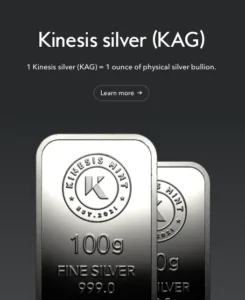
Kinesis Silver (KAG) is a digital asset representing ownership of one ounce of physical, allocated and insured silver bullion, with its 1:1 backing independently audited twice a year by Bureau Veritas. KAG transforms allocated silver into digital silver that can be transferred, spent and redeemed. It is one of the two primary precious-metal currencies underpinning the Kinesis Monetary System, alongside KAU, which represents one gram of allocated gold. Together, they are intended to form the foundation of a monetary system built around physical precious metals.
Silver has served as both money and a store of value for thousands of years. Ancient civilisations, including the Greeks, Romans and Chinese, used silver coinage extensively, while the Spanish silver dollar became one of the first truly global currencies of trade. KAG gives that role a modern form by allowing allocated silver to circulate digitally without requiring physical bullion to be moved for every transaction.
The investment-grade silver bullion backing KAG is held in insured vaults across major international hubs, including London, New York, Zurich, Dubai, Hong Kong, Singapore, Sydney, Toronto and others across six continents. Silver with a fineness of 999 meets the recognised standard for investment-grade bullion used by institutional refiners and vaults worldwide. The term “investment-grade silver” generally refers to bullion with a minimum fineness of 999 parts per thousand, distinguishing it from sterling silver (925 fineness) or coin silver (900 fineness), which contain alloying metals and are not acceptable for settlement in wholesale bullion markets.
Rather than operating solely as an investment platform, the Kinesis Monetary System brings several financial services together within a single ecosystem:
- Digital wallets for holding allocated gold and silver
- A trading exchange for precious metals and supported digital assets
- Peer-to-peer transfers
- Payment functionality
- Physical bullion redemption
- Fee-sharing through the Kinesis yield system
The aim is to make precious metals practical as digital money while preserving direct ownership of the underlying bullion. Instead of requiring investors to purchase bars, arrange vault storage and organise transportation themselves, Kinesis brings these functions together within a single digital infrastructure while maintaining allocated ownership of the underlying metal.
Key Features Of KAG
One Troy Ounce Of Allocated Silver
The troy ounce, weighing 31.1035 grams, is the standard unit of measurement for precious metals, distinct from the avoirdupois ounce used for most other commodities, which weighs 28.3495 grams. This distinction dates back to the Roman monetary system and was standardised through the coinage reforms of the British Empire.
Every KAG represents one troy ounce of fully allocated physical silver. Ownership is linked directly to identifiable bullion held within the vault network rather than to a pooled inventory. The physical metal is held separately from company assets, so ownership remains directly connected to the account holder rather than to a pooled investment vehicle.
Independent Audits
The physical reserves supporting KAG are independently audited on a regular basis—specifically through independent biannual physical audits conducted by Bureau Veritas (Inspectorate)—to verify that the quantity and quality of vaulted silver correspond to the number of KAG units in circulation. As is customary in the precious-metals industry, this process has two components: reconciling paper records with serial numbers and bar weights, and conducting a physical count by independent inspectors.
Professional Vault Storage
Institutional vaults are generally classified into three security tiers: Grade I vaults are built into bedrock or building foundations and incorporate multiple perimeter defences; Grade II vaults are heavy-steel rooms equipped with combination locks and alarm systems; and commercial depositories provide varying levels of security suited to smaller holdings. Most major bullion banks use Grade I or equivalent facilities.
The silver backing KAG is stored in insured, institutional-grade vaults across multiple international bullion centres, operated by professional storage providers including Loomis, Brink’s, Malca-Amit and others. Geographic diversification reduces dependence on any single storage location while providing access to major global precious-metals markets. Institutional silver vaults generally maintain continuous surveillance, dual-control access protocols and comprehensive insurance coverage.
Blockchain Settlement
Settlement finality in blockchain systems refers to the point at which a transaction becomes irreversible. Unlike traditional financial settlements, which may take days to clear through central counterparties and correspondent banking networks, blockchain settlement reaches finality once a transaction is included in a confirmed block, typically within seconds or minutes depending on the network.
Although KAG is backed by physical silver, transfers of ownership are completed digitally through the Kinesis blockchain. This enables rapid settlement—usually within seconds—while maintaining an immutable record of transactions and ownership.
Divisibility
Physical silver coins and bars have historically been constrained by fixed denominations, limiting their usefulness for smaller payments.
The smallest physical silver coin commonly minted is the 1/10 troy ounce, while the smallest gold coin is often 1/20 troy ounce. Digital divisibility takes this granularity far beyond the capabilities of physical minting, enabling micro-transactions down to thousandths of an ounce that would be economically impractical with physical metal because of fabrication and handling costs.
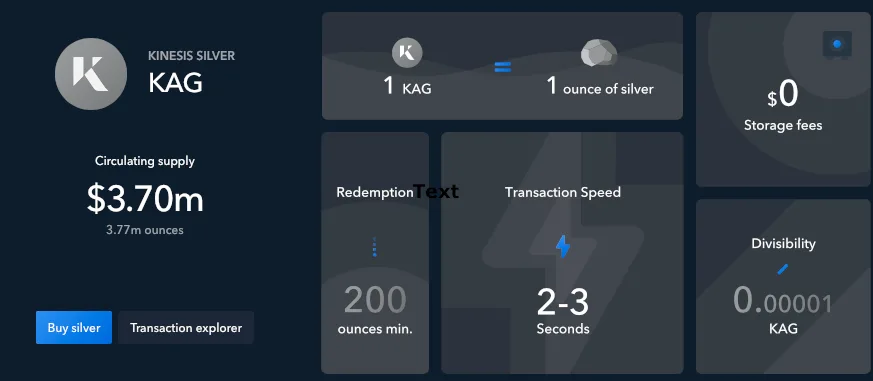
While each KAG represents one troy ounce of silver, users can transact in fractional amounts within the platform. KAG is divisible to five decimal places, allowing small everyday amounts to be transferred or spent without the need for whole-ounce bars, and making transactions possible that would be impractical with physical coins or bars.
Accessibility And Everyday Versatility
Moving physical silver across borders has traditionally involved substantial freight costs, security arrangements and customs procedures. International shipments of physical bullion require specialised logistics, including armoured transport, customs documentation and insurance covering the full market value. These costs typically range from 1% to 3% of the metal’s value for insured delivery, making physical transfers prohibitively expensive for small amounts and creating a strong case for digital representation.
KAG removes the traditional frictions associated with physical silver ownership while preserving direct title. Its digital format supports several practical uses within the Kinesis Monetary System:
- Spend as currency: Use KAG directly for goods and services through the Kinesis Virtual Card or Kinesis Pay.
- Exchange or convert: Trade KAG against KAU, Currency One stablecoins, selected cryptocurrencies or fiat pairs on the Kinesis Exchange with minimal friction.
- Transfer globally: Send holdings to friends, family or business partners anywhere in the world almost instantly for a 0.45% fee.
- Hold digitally: Own silver without arranging personal vault storage.
- Redeem for physical silver: Request delivery of the underlying bullion once the minimum quantity is met (typically 200 ounces), subject to applicable fees and logistics.
How To Purchase KAG
After creating and verifying a Kinesis account (KYC required), and funding it with supported fiat or digital currencies, there are two primary routes available, depending on how much control or simplicity you prefer:
Dashboard Route:
- Log into your Kinesis account.
- Go to the main screen and click the Buy widget.
- Enter the amount of silver you wish to purchase.
- Confirm the transaction at the live market rate.
- Purchased KAG is credited to your wallet immediately after settlement.
Kinesis Exchange Route: For those who prefer a full trading environment, the dedicated exchange provides live pricing, market charts, limit or market orders, and more granular control, while keeping the process efficient and maintaining direct exposure to allocated physical silver.
Alternative Acquisition Methods: a) mint KAG by depositing qualifying physical silver that meets ABX quality standards (Exchange Physical for Digital); b) receive KAG through a peer-to-peer transfer from another user.
Either way, the system keeps fees low and removes many of the usual barriers that once made physical silver investing feel distant or expensive.
Pricing, Fees And Storage
Pricing
Kinesis keeps KAG buy/sell spreads low by drawing on the advantages offered by the ABX:
- Global reach through the ABX network: Pricing aggregates data from ABX’s primary trading centres across major international hubs. Kinesis sources precious metals through the global ABX network, an institutional infrastructure that aggregates real-time data from major trading centres worldwide.
- Real-time market alignment: Every quote updates live to reflect current conditions worldwide. What you see on screen reflects the actual market, with no hidden mark-ups or outdated figures.
This structure provides institutional-grade spreads and removes many of the mark-ups commonly found in retail bullion markets.
Transaction Fees
Trading on the Kinesis Exchange carries a 0.22% fee; transfers cost 0.45%.
Transaction fees in traditional card-payment systems typically comprise interchange fees paid to card issuers, network or scheme fees paid to card networks such as Visa or Mastercard, and acquiring or processing fees. For many merchants, these combined costs can amount to roughly 2%–4% of the transaction value, significantly higher than the 0.45% transfer fee on the Kinesis network.
Zero Storage Fees
In conventional markets, annual storage and insurance fees for allocated silver often range from 0.4% to more than 1% of the metal’s value because of its greater bulk relative to gold. A major advantage of holding silver within the Kinesis Monetary System is the elimination of storage fees. Unlike many traditional allocated-silver storage arrangements, Kinesis does not charge ongoing storage fees for silver held within the platform. The cost of vaulting, insurance and administration is covered by platform transaction-fee revenue rather than charged to holders of allocated metal.
Spending Digital Silver
Silver has historically been used for everyday coinage in many economies because its lower unit value made it more practical for ordinary transactions than gold. One of KAG’s defining characteristics is that it is intended to function as spendable money rather than solely as an investment. Instead of selling silver before making a purchase, eligible users can transact directly using their digital silver balance. By combining physical bullion ownership with digital payment infrastructure, KAG allows silver to participate in everyday transactions without first converting it into cash. This extends silver’s traditional monetary role into modern financial systems.
Through supported Kinesis payment services, users can a) transfer KAG directly to other account holders; b) settle international payments; or c) spend eligible balances using supported payment products, including the Kinesis Virtual Card. The result is a straightforward bridge between silver’s traditional role as a store of value and the pace of modern finance. Users gain the steadiness of a precious metal without giving up the convenience of instant transactions.
Yields
Holder’s Yield
Holding KAG within the Kinesis ecosystem generates passive income. The Kinesis Monetary System includes a fee-sharing mechanism known as the Holder’s Yield. Fifteen percent of the global transaction-fee revenue generated across the system (the Master Fee Pool) is allocated to the Holder’s Yield and distributed monthly to eligible KAG holders, paid in additional physical silver. Rather than generating interest on deposited silver, eligible KAG holders receive distributions funded by a share of transaction fees generated throughout the ecosystem.
Velocity Yield
This is the reward for spending and trading KAG, creating incentives aligned with the actual use of silver as money.
Physical Redemption
KAG maintains its direct connection to physical silver through redemption. Once the applicable minimum redemption thresholds (typically 200 ounces) and associated fees are met, eligible users may request delivery of physical bullion from the Kinesis vault network.
- Available products, redemption quantities and delivery options may vary depending on vault location and jurisdiction
- Delivery is arranged through the ABX logistics network
This redemption capability distinguishes KAG from many financial products that provide only price exposure to silver without allowing investors to obtain the underlying metal. Physical silver bars and coins remain subject to the same purity and weight standards used in institutional markets worldwide.
The LBMA Good Delivery list specifies approved refiners whose bars are accepted for settlement in the London wholesale market. As of the most recent listing, approximately 70 refiners globally are approved for gold and 100 for silver, with each bar’s serial number, assay mark and fineness stamped into the metal. Redeeming KAG for physical bars typically requires the bars to meet these standards to ensure their acceptance in the broader wholesale market.
Summary: A Silver Based Monetary Ecosystem
Taken together, these features make KAG more than simply another digital token. The result is a closed-loop system in which allocated silver can be:
- Held as a store of value
- Transferred as digital cash
- Spent at the point of sale
- Redeemed as physical bullion
- Earn a share of system fees
To date, Kinesis KAG is one of the most widely available digital assets based on physical silver that is simultaneously fully allocated, audited, spendable and redeemable. These features combine to turn physical silver into something people can actually use, hold, save and earn with confidence—qualities rarely brought together in traditional silver accounts, ETFs or most other tokenised metals.
Exchange-traded funds (ETFs) backed by physical silver typically charge expense ratios of between 0.15% and 0.50% annually, covering storage, insurance and management costs. Unlike allocated digital silver, ETF holders do not have direct legal title to the underlying metal and cannot redeem their shares for physical bullion—they hold shares in a trust that owns the metal, making them indirect beneficiaries rather than direct owners.