

Table Of Contents
Market Shortcomings And Kinesis Solution
Fiat currencies face ongoing inflation that erodes purchasing power, while many cryptocurrencies exhibit high volatility that limits their use in commerce. The Kinesis Monetary System addresses these issues with KAU and KAG—digital tokens fully backed 1:1 by physical gold and silver stored in audited vaults worldwide.
The model combines the historical stability of precious metals with blockchain’s fast, low-cost transfers and transparent records. Amid continued central-bank stimulus and the expansion of digital assets, Kinesis offers a hybrid approach: sound-money characteristics adapted for digital transactions, with built-in rewards for active use.
1) Cryptocurrency Market Shortcomings: Volatility
Cryptocurrencies face a persistent hurdle: extreme price swings that make them unreliable as either a store of value or a practical medium for everyday commerce. Bitcoin might double in a month, then drop 40 percent the next. That kind of movement erodes confidence. Businesses hesitate to accept crypto payments or hold reserves in it—the risk to profit margins is simply too high.
Money’s core job is to make transactions smooth and predictable. When the unit of account itself fluctuates wildly, that job becomes much harder. Early cryptocurrencies deserve credit, though. They proved decentralized payments could work at scale and paved the way for more stable experiments, including the Kinesis Monetary System.
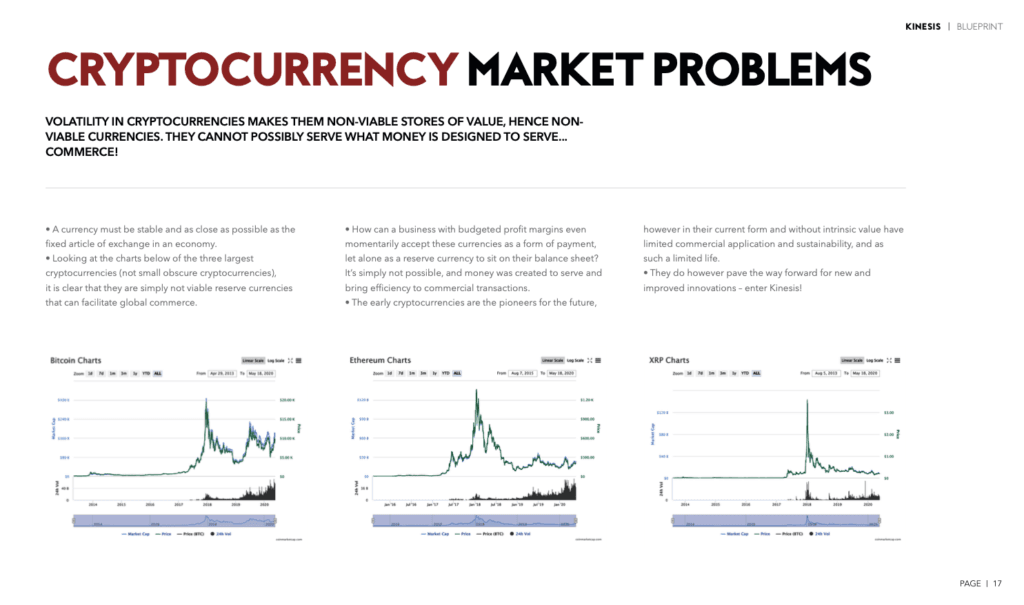
Kinesis Solution: KAU and KAG inherit the volatility profile of physical gold and silver. Measured in real purchasing power—how much bread, fuel, or housing a unit buys—precious metals have shown far greater stability than fiat currencies over long periods. Governments can print dollars, euros, or yen at will. No one can print more gold or silver.
That physical limit keeps KAU and KAG anchored. Their price in fiat terms can rise or fall with market sentiment, but their ability to purchase goods and services tends to hold steady across decades. History backs this up: gold has preserved wealth through inflation cycles, currency devaluations, and economic crises where paper money lost ground.
2) Fiat Currency Market Shortcomings
Central banks and governments have leaned heavily on expansive monetary policy—printing money and deliberately weakening currencies—to juice growth. The tactic worked for a while. Today the returns are shrinking, and the side effects are mounting.
The Mechanism Of Currency Devaluation
Central banks pump tons of extra currency into the markets, which pushes banks to lend more aggressively. That boost consumer spending—people feel richer on paper (thanks to rising asset values), so they spend more freely, and nominal GDP gets a nice lift. But over time, the magic wears off. Debt piles up everywhere, asset bubbles start inflating, and eventually the system needs bigger and bigger doses just to get the same short-term buzz.
Impact On Purchasing Power And Savings
Inflation eats away at real value. Prices climb faster than wages in many cases. Savings accounts pay interest well below inflation, so depositors lose ground year after year. A dollar saved in 2010 buys noticeably less today.
Risks Associated With Bank Deposits
Banks can become fragile. Bail-in rules—introduced after 2008—allow authorities to convert uninsured deposits into equity during a crisis. Deposit insurance caps often fall short of full coverage in larger accounts. In extreme scenarios, savers face haircuts.
A Global Trend With Widespread Consequences
Many governments now finance deficits directly through central-bank purchases of bonds. History offers warnings: repeated over-issuance has triggered currency collapses, runaway inflation, and in the worst cases hyperinflation that wiped out middle-class savings.
In Summary
Reliance on money creation carries heavy costs:
- Wealth erosion hits everyone, but hardest on those living paycheck to paycheck.
- Inequality widens as asset owners benefit from inflation while wage earners fall behind.
- Financial systems grow brittle under constant intervention.
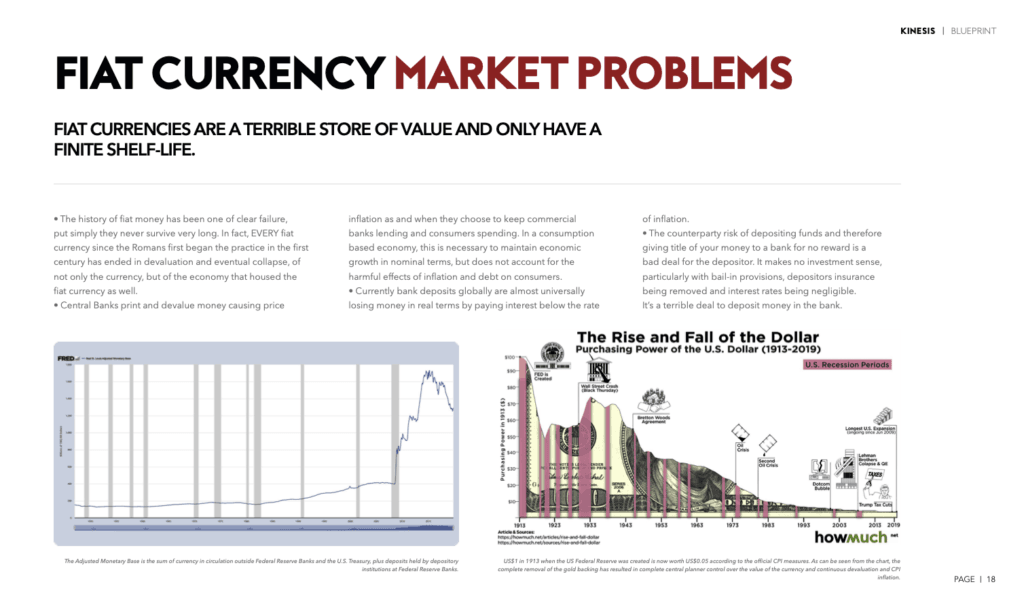
Kinesis Solution: Gold and silver cannot be printed.
3) Asset Backed Currencies Shortcomings
Gresham’s Law: “Bad Money Drives Out Good Money”
According to Gresham’s Law people spend the weaker currency and hoard the stronger one. Gold and silver end up in safes instead of circulation. That dynamic has kept precious metals on the sidelines as transactional money for generations.
Yield: The Challenge Of Income Generation
Physical bullion sits idle. It pays no interest and often incurs storage or insurance costs. Compared with bonds, dividend stocks, or even high-yield savings accounts, pure metal looks less attractive for income seekers.
Security: Trust And Transparency In Asset-Backed Currencies
Past scandals—missing reserves, unverified bars, opaque audits—have left scars. Skepticism lingers whenever someone claims “fully backed” without ironclad proof.
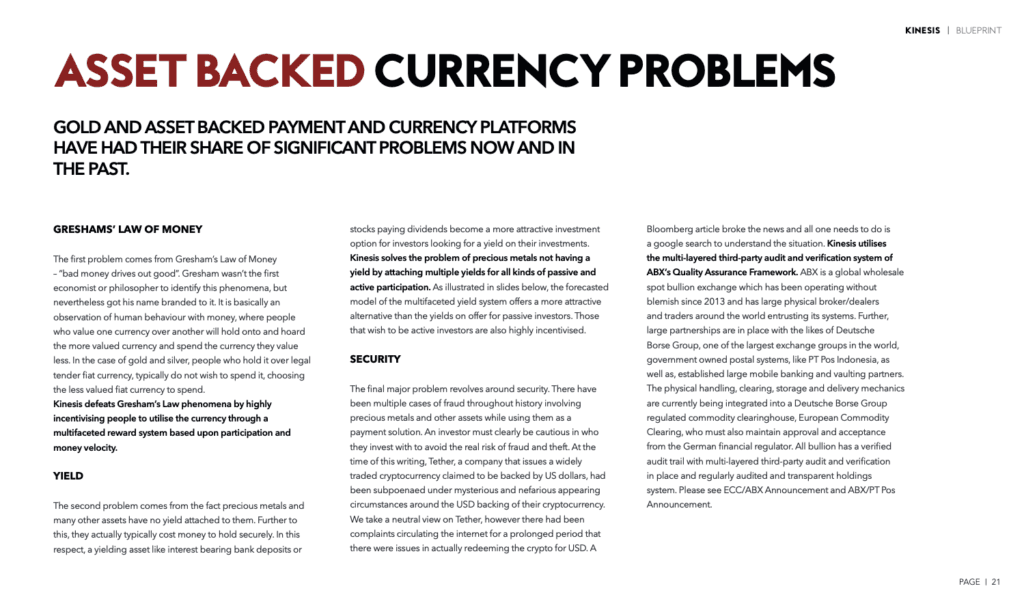
Kinesis Solution: The platform tackles these issues head-on:
- Gresham’s Law is countered with direct incentives to circulate good money: a) Incentivized Circulation: Rewards for spending, trading, and sending KAU and KAG encourage movement. b) Velocity-Based Rewards: The faster money circulates, the higher the potential returns. c) Behavioral Shift: Tangible benefits flip the incentive structure—users gain more by using sound money than by locking it away.
- Yield Limitations are addressed through a multi-layered fee-sharing system that rewards both holding and active use.
- Security Concerns are met with blockchain transparency, biannual independent audits by Inspectorate International (Bureau Veritas), and public access to the Kinesis Explorer for real-time supply verification.
4) Bullion Market Shortcomings
Antiquated And Inefficient Market
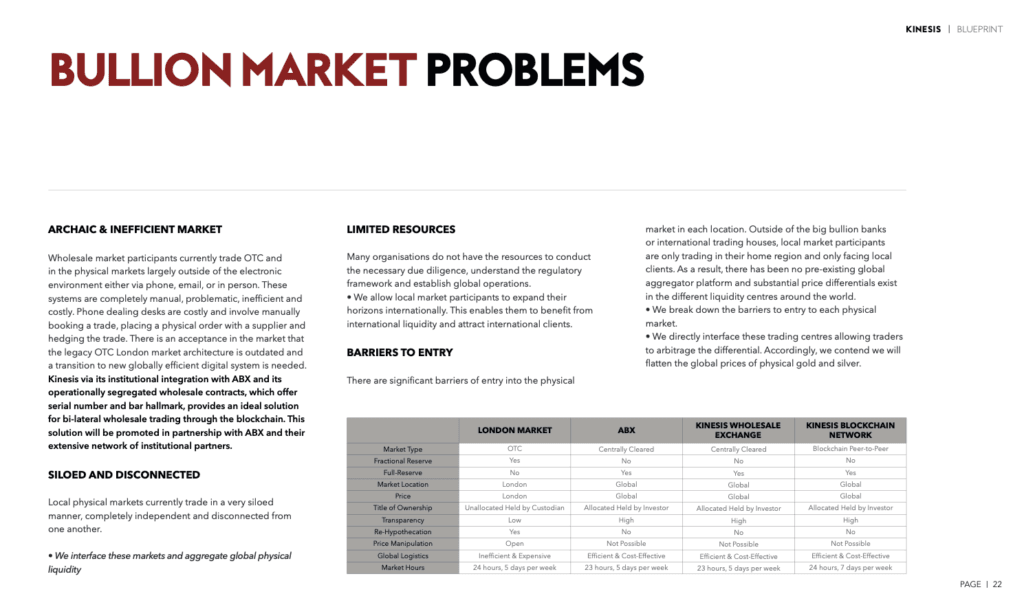
Most physical bullion trades still happen over-the-counter—phone calls, emails, manual confirmations. Deals take time. Hedging is cumbersome. Costs creep up through layers of intermediaries.
Kinesis Solution: Through its partnership with Allocated Bullion Exchange (ABX), Kinesis runs a blockchain-based wholesale trading platform. Bilateral trades execute digitally and automatically. The old OTC model gives way to a streamlined, lower-cost environment.
Market Isolation And Inefficiency
Regional bullion markets often operate in silos. Liquidity stays trapped locally. Global price discovery suffers.
Kinesis Solution: Kinesis works toward a unified global liquidity network. Disconnected markets link up. Standardized pricing becomes more achievable.
Limited Resources For Market Participation
Smaller dealers, refiners, and jewelers struggle with international compliance, due diligence, and cross-border logistics.
Kinesis Solution: The platform opens global access. Local players reach international buyers and sellers through a single, compliant interface.
Barriers To Entry
High entry costs and regulatory complexity confine many participants to their home markets. Price gaps persist across regions.
Kinesis Solution: By connecting trading centers, Kinesis reduces those barriers. Arbitrage opportunities emerge. Efficiency improves as capital flows more freely.
Lack Of Access For Producers And Manufacturers
Producers sell through brokers who take a cut. Manufacturers pay inflated prices after multiple mark-ups.
Kinesis Solution: ABX allows suppliers to act as direct liquidity providers—selling at the offer price instead of accepting the lower bid. End-users—jewelers, mints, investors—access the same exchange without intermediaries. The model shortens the chain and captures more value for both sides.
The ABX and Kinesis teams argue this shift could reshape price discovery. Today futures and OTC markets dominate benchmarks, often detached from physical supply and demand. Direct participation by producers and consumers pulls the process closer to real fundamentals. More suppliers joining the exchange could create momentum: greater volume, tighter spreads, and stronger transparency. If the vision holds, ABX may emerge as a central hub for physical metals trading—challenging entrenched intermediaries and injecting more fairness into the industry.
Conclusion
Inflation, cryptocurrency volatility, and inefficiencies in traditional bullion markets highlight clear limitations in current monetary and commodity systems. Kinesis counters these with tokens tied to audited physical gold and silver, fee-sharing incentives that promote circulation over hoarding, and public blockchain visibility supported by biannual third-party audits. Whether it scales widely or remains a specialized option, the platform demonstrates how precious metals can function as transactional money again. By allowing spending, trading, or holding with yields while preserving long-term stability, Kinesis adapts proven sound-money principles to a digital framework.