
Table Of Contents
Kinesis Money Explained: Goals, Foundations and Infrastructure
Kinesis Money is a blockchain-based monetary platform (launched in 2018) that digitizes ownership of allocated, insured, and independently audited physical gold and silver into digital currencies that users can buy, sell, spend, and trade. Its two primary digital currencies are KAU and KAG. One KAU — Kinesis’ digital gold currency — represents one fine gram of physical gold, while one KAG — Kinesis’ digital silver currency — represents one fine troy ounce of physical silver. The system uses transaction fees to fund a series of user rewards called yields, creating an economic incentive for people to use KAU and KAG instead of fiat currencies. Kinesis’s core idea is to move gold and silver beyond mere investment or savings vehicles and make them usable as money, by combining the monetary properties of precious metals with the speed and accessibility of blockchain technology.
The whole idea of the Kinesis Monetary System rests on a few key concepts that set it apart from both traditional banking and most cryptocurrencies: currency is backed by physical gold and silver (which is why it’s considered an evolution of the old gold standard), yields are earned through actual contributions to economic activity and growth (rather than simply through lending debt), and the whole system runs on blockchain tech for transparency, efficiency and security.
To make it all work in practice, the system is built around four main pillars: the Kinesis Mint (where the digital currencies get created against real bullion), the blockchain network itself (handling transfers and the public ledger), the financial network (think payments, wallets, debit cards, and everyday spending), and the commercial center (a hub for merchants and businesses to accept and use KAU and KAG in real transactions).
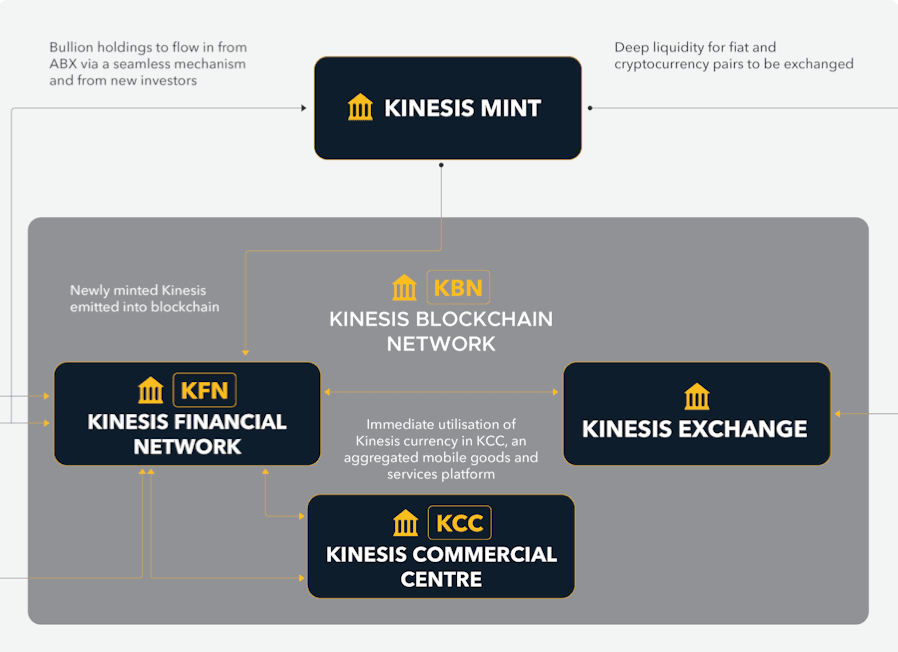
NB This article is based on the original Kinesis whitepaper and blueprint. Over the years the Kinesis Monetary System has evolved and partly departed from that early structure (particularly regarding the Commercial Centre). Nevertheless, presenting the Kinesis Monetary System through the lens of the original blueprint remains useful. The accompanying graphic (see below), which maps the ecosystem in its original structure, also remains, in my view, a valuable reference for understanding how the various components of the system fit together.
The Problem: Monetary Inflation And Currency Devaluation
In his 1966 essay Gold and Economic Freedom, long before becoming the 13th Chairman of the Federal Reserve, Alan Greenspan offered a striking explanation of why he believed the gold standard had come under sustained attack: “In the absence of the gold standard, there is no way to protect savings from confiscation through inflation. There is no safe store of value. … The financial policy of the welfare state requires that there be no way for the owners of wealth to protect themselves. This is the shabby secret of the welfare statists’ tirades against gold. Deficit spending is simply a scheme for the confiscation of wealth. Gold stands in the way of this insidious process. It stands as a protector of property rights. If one grasps this, one has no difficulty in understanding the statists’ antagonism toward the gold standard.”
Whatever one’s view of the gold standard, the broader concern A. Greenspan identified remains relevant: fiat currencies are not fixed stores of value. Over time, persistent inflation reduces their purchasing power.
Unfortunately, while fiat currencies steadily lost purchasing power, gold was increasingly pushed to the margins of finance and monetary discourse. In A Tract on Monetary Reform (1923), J. M. Keynes had already characterised the gold standard as a barbarous relic. In a July 2015 column for The Wall Street Journal titled “Let’s Be Honest About Gold: It’s a Pet Rock”, financial journalist Jason Zweig famously defined gold as a pet rock, an expression that became a shorthand for the broader critical view of gold as an investment. Financial analysts largely shared Warren Buffett’s dismissive view that gold was just an unproductive asset sitting idle in a vault. The most famous quote attributed to him on the topic sums it up: “Gold gets dug out of the ground in Africa, or someplace. Then we melt it down, dig another hole, bury it again, and pay people to stand around guarding it. It has no utility.”
But the change was about more than gold’s status as an investment. Its much older role as money was also pushed into the background. In modern monetary systems, and in much of the financial commentary surrounding them, gold gradually came to be treated as though its monetary history were largely irrelevant to the present. This assumption can be seen in something as ordinary as online investing forums, where gold is usually discussed under commodities rather than currencies, as though its centuries-long monetary role were merely a historical curiosity. It was also captured memorably during Ben Bernanke’s testimony before the House Financial Services Committee in 2011. When Rep. Ron Paul asked why central banks continued to hold gold if it was not money, Bernanke answered with a single word: tradition.
The Solution: Restoring Sound Money Through A New Gold Standard
In 1830, the British economist Nassau William Senior observed that “the portableness of the precious metals and the universality of the demand for them render the whole commercial world one country, in which bullion is the money.” While gold-backed tokens such as Pax Gold and Tether Gold are primarily designed as investment products, KAU and KAG are intended to function as digital currencies, bringing precious metals back into a role they occupied for much of human history: users can transfer Kinesis currencies instantly between wallets; the Kinesis Card works like a regular payment card, converting gold and silver holdings into local currency in real time at checkout; merchants can accept payments in precious metals through Kinesis Pay. In each case, the aim is to give gold and silver a practical monetary function again, rather than leaving them confined to the role of investment assets sitting in a vault.
The term gold standard historically refers to a monetary system where a country’s currency or paper money has a value directly linked to gold. Under the gold standard, participating countries fixed their currencies to a specified gold weight, and gold coins circulated alongside paper notes freely convertible into gold. The Bretton Woods system, established in 1944, created a new international monetary order where the US dollar was convertible to gold at $35 per ounce, and other currencies were pegged to the dollar. This arrangement lasted until 1971, after which most major economies transitioned to fiat currencies—money backed only by government decree rather than physical commodities.
Platforms like Kinesis can be understood as a kind of Gold Standard 2.0. The concept is not to recreate the monetary system of the nineteenth century, but to combine one of the oldest forms of sound money with the technological infrastructure of the digital economy: gold provides the underlying monetary asset; digital technology provides the speed, divisibility, portability, and convenience that physical bullion has traditionally lacked.
Gold Standard 2.0 then—but with a caveat: participation is voluntary. Individuals and businesses can decide whether they want to transact in precious metals or not, they are not required to abandon national currencies, nor are they forced into a single monetary arrangement imposed from above. This distinction brings the idea of Gold Standard 2.0 close to one of Friedrich Hayek’s central convictions in A Free Market Monetary System, namely that if we are ever to re-establish sound money, the solution would likely not be provided by the public sector: “I am more convinced than ever that if we ever again are going to have a decent money, it will not come from government: it will be issued by private enterprise, because providing the public with good money which it can trust and use can not only be an extremely profitable business; it imposes on the issuer a discipline to which the government has never been and cannot be subject.”
To me, this voluntary character — and the currency competition it fosters — is one of the most compelling aspects of the model. Rather than waiting for governments and central banks to improve the monetary system, it gives individuals and businesses the ability to choose among different forms of money. In that sense, it introduces what might reasonably be called free currency choice.
The Foundations Of The Kinesis Monetary System
1. Allocated Gold and Silver and Why The Allocated Bullion Exchange Matters
Kinesis’ native digital currencies, KAU (gold) and KAG (silver), are fully backed by a 1:1 allocated physical vaulted bullion. This direct tie to tangible metal gives KAU and KAG a level of stability in terms of purchasing power that suits them for long-term holdings, business dealings, and routine payments—far removed from the steady devaluation that fiat currencies are subject to and the sharp swings seen in many unbacked cryptocurrencies.
The infrastructure underpinning the physical gold reserves that back KAU and KAG—including bullion custody, logistics, transportation, security, storage, and the associated operational processes—is managed and coordinated by the Allocated Bullion Exchange.
This is an important but easily overlooked part of the model: digital ownership of physical bullion only works if there is a reliable system behind the screen. Someone has to store the metal, maintain accurate ownership records, reconcile transactions, move bullion when necessary, and ensure through regular audits of the metal inventories that the quantity recorded in the system corresponds to the physical assets held in custody. The custody infrastructure of ABX addresses those requirements.
2. Yields
Unlike conventional systems that rely on debt creation to generate returns, Kinesis draws its yields from actual transaction activity across the platform. The model rewards users directly for holding, spending, trading, or referring others—turning everyday participation into a source of passive or active income in gold and silver.
In traditional banking, the primary mechanism for generating returns is fractional reserve lending, where banks accept deposits and lend out a portion to borrowers, creating new money in the process. Interest charged on loans exceeds interest paid on deposits, with the difference (the spread) generating bank profits. This system inherently creates debt as a prerequisite for yield, whereas the Kinesis model generates yields from transaction velocity without creating new debt.
3. Distributed Ledger Technology (DLT)
The entire Kinesis platform runs on its own blockchain network, the Kinesis Blockchain Network (KBN). The KBN facilitates the exchange, storage, spending, and transfer of KAU and KAG. Like other distributed ledger technologies, the KBN is designed to provide advantages over traditional centralized databases, including greater transparency and reduced reliance on a single central authority. Data is replicated across multiple nodes and secured using cryptographic mechanisms and consensus protocols, making the ledger resistant to unauthorized alteration and enabling transactions to be independently verified.
This element of the Kinesis Monetary System—the blockchain—is the aspect that draws the strongest resistance among those who otherwise are strong proponents of gold and sound money: a deep-seated distrust of currencies running on blockchain technology, and a refusal to accept gold being integrated into digital payments. It is easy to forget that new forms of payment have often been met with skepticism precisely because they disrupt familiar habits: when credit cards first appeared, many people questioned whether consumers would really trust a piece of plastic in place of cash; online banking encountered much the same resistance, with plenty of people insisting they would never entrust their money to the internet and would always prefer to conduct their financial affairs in a physical bank branch. Today, both credit cards and online banking are so commonplace that it is hard to imagine how radical they once seemed.
The Infrastructure Behind The Kinesis Monetary System
To make these principles work day-to-day, the system is built around four interconnected parts, each functioning as a distinct part of the overall infrastructure. Together, they handle everything from creating the digital currencies to enabling everyday use.
1. Kinesis Currency Mint
Within the Kinesis Monetary System both the physical facility in Istanbul that produces Kinesis bullion and the digital platform that issues Kinesis’ currencies are referred to as the Kinesis Mint, just to keep things simple. In the articles in this website I refer to the digital platform responsible for issuing KAU and KAG as the Kinesis Currency Mint and to the facility in Istanbul as to the Kinesis Bullion Mint.
The Kinesis Currency Mint acts as the wholesale operation for issuing new KAU (gold-backed) and KAG (silver-backed) tokens. Minting only occurs when an equivalent amount of bullion is deposited and fully allocated in vaults managed through the Allocated Bullion Exchange (ABX). ABX provides the market infrastructure and institutional connections through which the Mint can access bullion liquidity, trading counterparties, and established precious-metals markets to support the acquisition and allocation of the bullion underlying newly issued tokens.
Kinesis KAU and KAG operate on a full-reserve model, meaning each digital token is backed 1:1 by a corresponding unit of physical metal held in custody—one gram of gold per KAU and one ounce of silver per KAG. This stands in contrast to fractional-reserve systems, where only a portion of issued claims are covered by actual reserves on hand, with the remainder being created through lending activities. In a fractional framework, the circulating supply of redeemable claims can exceed the available backing asset, introducing counterparty risk and the theoretical potential for a liquidity crisis if all holders demanded simultaneous redemption. Kinesis’ full-reserve structure avoids this dynamic by ensuring that every token in circulation has a dedicated, audited physical counterpart in storage, maintaining a direct and transparent link between the digital representation and its underlying commodity.
2. Kinesis Blockchain Network
The Kinesis Blockchain Network is the proprietary, foundational blockchain infrastructure where KAU and KAG tokens are stored, transferred, and tracked. Newly minted currencies enter circulation directly here, linking the physical bullion backing to the digital side. The network handles all movement within the system, supporting the core mechanics of ownership and transactions. Blockchain networks record each transfer as a permanent, time-stamped entry that can be independently verified by any participant.
The KBN is a custom, optimised fork of the Stellar blockchain, purpose-built by the Kinesis team. It is not the public Stellar network. Instead, it is a dedicated single-asset (or dual-native-asset) ledger designed specifically for gold- and silver-backed digital currencies.
According to Kinesis, it is hosted on Amazon Web Services (AWS) across three global regions, providing triple redundancy to prevent downtime. Network consensus is secured through a model requiring 5 nodes to agree, with only 3 trusted nodes per region, meaning at least two regions must cooperate to validate transactions, protecting against regional failures or attacks.
3. Kinesis Financial Network
While the blockchain tracks ownership, the Kinesis Financial Network is the user-facing interface for spending, saving, remitting, and moving value. In the original Kinesis architecture (detailed in the whitepaper and blueprint), the KFN was designed as a mobile banking and payments system, providing the practical tools that let people treat KAU (gold) and KAG (silver) as everyday money.
Users access it primarily through the Kinesis mobile app and web platform. It includes a digital wallet that holds KAU, KAG, and other supported assets. A key component is the debit/virtual card facility (Mastercard/Visa-linked in the original design, later evolved into the Kinesis Virtual Card). This converts gold or silver holdings into spendable value at merchants worldwide. Merchants can integrate via APIs or tools (such as Kinesis Pay) to accept payments in Kinesis currencies. But the KFN extends its utility to businesses beyond just accepting payments. The Kinesis Pay merchant solution allows businesses to accept payments in gold, silver, crypto, and stablecoins with zero transaction fees – i.e. at lower cost than traditional card processing – and instant settlement with balances viewable in preferred fiat currencies for convenience, directly through a website plug-in or in-store QR codes. To further support this, Kinesis has launched a global Merchant Directory to connect these businesses with value-aligned customers, creating a self-sustaining economic circle where sound money is actively used.
The network includes tools for managing value at scale. For instance, the multi-asset payroll solution lets businesses pay employees or vendors in gold and silver, with the ability to schedule automated bulk transfers to up to 1,000 recipients simultaneously.
Beyond the spending and payment tools described above, the KFN is also a complete ecosystem for building recurring wealth through Kinesis’ yield system.
The purpose of the KFN is to solve the classic problem of gold and silver: they are excellent stores of value but historically poor media of exchange. By adding mobile banking, cards, remittances, and merchant tools on top of the blockchain ledger, KFN aims to restore the full monetary functions of precious metals—saving, spending, and transferring—while keeping the underlying metal fully allocated, yield-bearing, and redeemable. In short, the Kinesis Blockchain Network records who owns the metal; the Kinesis Financial Network is the set of tools that lets people actually use that metal as money in daily life.
4. Kinesis Commercial Centre
In the early Kinesis architecture (as described in the whitepaper and blueprint), the Kinesis Commercial Centre was designed as an online aggregator platform that brings together goods and service providers. Its role was to create a marketplace where KAU (gold) and KAG (silver) can be used directly as payment for everyday purchases.
The concept reflected a broader lesson from the development of alternative payment networks: merchant adoption is critical to making a new form of payment useful. In the 1980s and 1990s, the expansion of credit card networks required significant merchant onboarding efforts, with early adopters gaining competitive advantages. Similarly, payment networks such as PayPal (founded 1998) and Stripe (founded 2010) built merchant ecosystems to expand their reach. In each case, network effects played a central role—the value of the payment network increased as more merchants and users joined, creating a virtuous cycle of adoption. The KCC was intended to apply this same principle to gold and silver as digital money, creating the merchant network necessary for KAU and KAG to be used beyond investment and savings.
The purpose of the KCC was therefore to close the final gap in making gold and silver function as real money: while the blockchain records ownership and the financial network provides wallets and cards, the Commercial Centre was meant to create actual places (digital and physical) where people could spend that gold and silver on goods and services. By aggregating merchants willing to accept KAU and KAG, it aimed to increase the velocity and everyday usefulness of the metal-backed currencies, generating more transaction volume and therefore more yields for the wider network.
In short: the Kinesis Commercial Centre was the planned marketplace layer that would turn gold and silver from a store of value into something you could routinely use to buy things.
In practice, the standalone “Kinesis Commercial Centre” brand has not remained a prominent, separate product. Its intended functions have been absorbed into the current Kinesis platform tools — particularly Kinesis Pay (merchant payment acceptance), the Merchant Directory/Map, and spending via the Kinesis Virtual Card or peer-to-peer transfers.