

Table Of Contents
Kinesis Gold (KAU): Digital Gold Backed 1:1 by Physical Gold
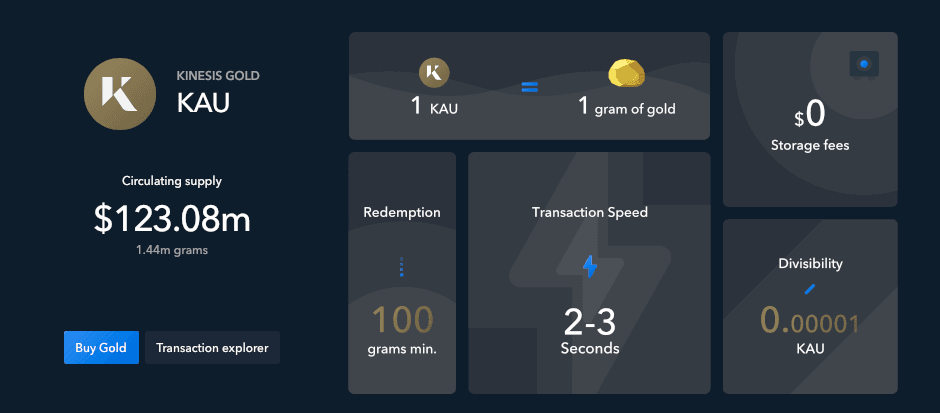
Kinesis Gold (KAU) is a gold-backed digital currency issued within the Kinesis Monetary System. Each KAU stands for one gram of fully allocated physical gold with a minimum purity of 999.9, stored in fully insured, independently audited vaults in major international bullion trading hubs. Gold of 999.9 fineness is usually called “four nines” fine and meets the highest institutional purity standards used in global bullion markets.
KAU is meant to combine the stability and long-established monetary role of physical gold with the speed, divisibility and global reach of blockchain-based digital payments.
How KAU Fits Within the Kinesis Monetary System
KAU is one of the two main currencies of the Kinesis Monetary System. Together with KAG, which represents one troy ounce of allocated silver, it makes up the base of a monetary setup built around fully allocated physical precious metals. The system brings several services together on a single platform:
- Digital wallets for holding gold and silver
- The Kinesis Exchange for trading precious metals and supported digital assets
- Peer-to-peer global transfers
- Payment services for everyday spending
- Physical bullion redemption
- A transaction fee-sharing model that passes yields on to eligible participants
By linking these services, Kinesis lets precious metals work as transferable digital currencies while keeping direct ownership of the underlying bullion.
Core Features and Benefits
Full Allocation, Legal Ownership and Transparency
Each KAU stands for one gram of specifically allocated physical gold. Unlike fractional-reserve systems, paper gold products or unallocated bullion accounts, Kinesis holders own the underlying physical bullion directly instead of holding a claim against pooled assets.
The gold stays in fully insured institutional vaults and is held in custody under a bailment arrangement, so holders keep legal title to the metal at all times. Because the bullion is legally owned by users and kept separate from Kinesis’s corporate assets, it stays off the company’s balance sheet and is never lent out. The bullion is managed through the Allocated Bullion Exchange (ABX)—a global institutional precious metals exchange started in 2011—with professional vault partners that include Brinks and Loomis Zurich.
Independent third-party audits are carried out regularly to check that every KAU in circulation is backed by one gram of physical gold. Audit reports are published openly, giving ongoing confirmation of the system’s 1:1 backing. Professional bullion vaults around the world normally require this kind of independent verification of weight, purity and serial numbers to keep institutional trust.
Global Accessibility
KAU lets users buy, sell, transfer and spend allocated gold from almost anywhere that has internet access. Its digital form takes away many of the usual obstacles tied to physical bullion ownership, such as shipping logistics, insurance administration, secure storage arrangements and minimum bar sizes.
Blockchain-based settlement finality works differently from traditional payment systems. In ordinary banking a transfer is usually provisional until the end-of-day reconciliation across central bank accounts; on distributed ledgers, settlement can reach finality in seconds through cryptographic consensus, no matter the national borders or banking hours. Transfers between users settle on the Kinesis blockchain without depending on traditional banking intermediaries, so KAU works for both international payments and longer-term savings.
Store of Value with Liquidity
Gold has long acted as a store of value in times of economic uncertainty, currency debasement and high inflation. KAU keeps this trait while offering markedly higher liquidity than ordinary physical bullion ownership. Rather than having to arrange the sale and delivery of physical bars, holders can trade or transfer their gold digitally at any time on the Kinesis platform. KAU is also divisible to five decimal places (0.00001 gram), which allows precise transactions while still keeping full backing by physical bullion. Physical gold bars, by comparison, are seldom practical for small everyday transactions because of their fixed sizes and handling costs.
For digital asset investors, KAU also offers an asset backed by physical gold that can serve as an alternative to fiat-backed stablecoins during stretches of cryptocurrency market volatility. Fiat-backed stablecoins hold their peg through reserve assets kept in bank accounts or short-term government securities, which brings in counterparty risk to the banking system and dependence on monetary policy. Gold-backed tokens, on the other hand, draw their value from a physical commodity with no issuer obligation beyond custody, so their risk profile differs in a basic way from that of dollar-pegged instruments.
Yields
In traditional banking, depository institutions create money through fractional reserve lending, where part of the deposited gold or currency is lent out to borrowers. The Kinesis model of full allocation stops this re-hypothecation, so the underlying gold is never used as collateral for loans or derivatives—a basic difference from the way commercial banks operate, where customer deposits regularly fund the credit creation process. Unlike interest-bearing financial products, yield distributions are funded by the transaction fees generated inside the Kinesis Monetary System. KAU can generate three kind of yields:
- Holder’s Yield – eligible KAU holders may receive a Holder’s Yield, funded from 15% of the global transaction fee revenue collected across the ecosystem and paid out monthly in physical gold.
- Minter’s Yield – distributes 5% of fee revenue to users taking part in the minting process of KAU and KAG.
- Velocity Yield – rewards spending and transacting KAU on the network.
Pricing and Ownership Costs
Kinesis sources precious metals through the Allocated Bullion Exchange (ABX), giving access to institutional liquidity across major international bullion markets. This structure brings several advantages: a) real-time pricing based on global bullion markets; b) wholesale spreads supported by international liquidity; c) competitive execution compared with many retail bullion dealers.
Trading on the Kinesis Exchange carries a 0.22% execution fee, while transfers between users incur a 0.45% transfer fee.
In the physical bullion market, storage and insurance fees are usually calculated as an annual percentage of the metal’s value, with rates that vary by jurisdiction, vault location and the quantity stored. These costs can significantly reduce long-term returns, especially for smaller holdings, and form one of the main drawbacks of direct bullion ownership compared with exchange-traded products or allocated digital alternatives. Unlike many traditional allocated bullion providers, Kinesis does not charge ongoing storage fees for KAU holdings. Vaulting, insurance and custody costs are covered by a portion of the transaction fees generated within the ecosystem, which removes the recurring storage and administration charges commonly linked with allocated precious metal ownership.
How to Purchase KAU
After creating/verifying a Kinesis account (KYC required), and funding it with supported fiat or digital currencies, there are two primary routes available, depending on how much control or simplicity you want:
Dashboard Path: sign in to your Kinesis account –> on the Home dashboard, open the Buy / Buy-Sell widget –> specify how much gold (in grams or equivalent value) you want to acquire –> review and confirm at the prevailing market price –> once settled, the KAU lands directly in your wallet.
Exchange Path: Users who want deeper tools can switch to the Kinesis Exchange. There you’ll find real-time quotes, interactive charts, the ability to place market or limit orders, and tighter control over timing and price—while still ending up with direct title to allocated physical gold.
Other Ways to Obtain KAU: a) convert eligible physical gold that satisfies ABX standards into digital form through the Exchange Physical for Digital (EPD) process, or mint new KAU in standard lots (typically starting at 100 grams) via the Kinesis Mint; b) accept a peer-to-peer transfer of KAU from another verified holder.
In every case the platform keeps costs competitive, eliminates conventional storage fees, and delivers fully allocated physical gold—each KAU equalling one gram of fine gold held in your name inside insured vaults.
Gold as Spendable Digital Money
Historically, gold circulated as coinage in many economies until the gradual shift to fiat money during the 20th century. The last major currency to cut its link to gold completely was the Swiss franc, which kept a 40% gold backing until 1999. Digital gold currencies make it possible to re-imagine this historical function, thanks to modern cryptographic infrastructure.
KAU is designed to work as both a long-term store of value and a practical medium of exchange (which, by the way, is precisely the definition of sound money). Rather than having to sell gold before spending it, Kinesis lets eligible holders transact directly with their gold balance. Through Kinesis payment services, users can a) transfer KAU instantly to other account holders; b) make international payments; c) spend KAU online or in physical stores using the Kinesis Virtual Card, which converts KAU into local fiat currency at the point of sale.
By combining allocated physical bullion with modern payment infrastructure, Kinesis brings back one of gold’s traditional roles as everyday money while keeping its function as a long-term store of value.
Storage, Security and Ownership
Institutional vault storage for precious metals usually involves multi-layered security measures such as biometric access controls, seismic-rated vaults, round-the-clock surveillance and armed security personnel. Major vault operators also keep comprehensive insurance policies that cover theft, fire and natural disasters, with coverage limits that match the full replacement value of the stored assets.
KAU removes the need for users to arrange personal vault storage or insure physical bullion themselves. The underlying gold stays in professional insured vaults run by institutional storage providers, while ownership is handled digitally through the Kinesis platform. This structure brings together institutional-grade custody with the convenience of digital account management.
Physical Redemption
The ability to redeem physical bullion sets KAU apart from many financial products that only give price exposure to gold without letting investors take delivery of the underlying metal. Eligible holders with balances of 100 KAU or more may redeem their digital holdings for LBMA Good Delivery standard gold bars, subject to the applicable redemption requirements and fees. The London Bullion Market Association (LBMA) Good Delivery List sets the global benchmark for the size, purity, appearance and refining standards of institutional gold bars accepted by major bullion banks and exchanges. Bars that meet this standard are accepted for settlement in the global over-the-counter bullion market, which ensures their liquidity and recognition across all the main trading centres.
Redemption is arranged through ABX’s global vault network, with available products, delivery options and jurisdictions that vary by vault location.
Summary: A Complete Gold Ecosystem
Gold-backed digital tokens form a subset of the broader class of asset-referenced tokens, which also cover tokens backed by fiat currencies, commodities other than gold, or baskets of multiple assets. The legal classification of these tokens differs by jurisdiction: some regulators treat them as commodities, others as payment instruments, and some as a novel category that needs its own frameworks.
KAU combines fully allocated physical gold ownership with blockchain-based transferability, creating a monetary system that brings savings, payments, trading and physical redemption together on a single platform. Its key features include:
- One gram of 999.9 fine allocated gold backing every KAU.
- Legal ownership under a bailment structure.
- Independent third-party audits and publicly available audit reports.
- Fully insured institutional vault storage.
- Zero ongoing storage fees for holders.
- Institutional pricing and liquidity through the Allocated Bullion Exchange.
- Fast global transfers that make use of the speed and efficiency of Stellar’s technology.
- Integrated trading against allocated silver, cryptocurrencies, stablecoins and fiat currencies on the Kinesis Exchange.
- Spending through Kinesis payment services and the Kinesis Virtual Card.
- Physical redemption from 100 KAU.
- Participation in the Kinesis transaction fee-sharing yield system.