

Table Of Contents
- The Productive Holder: Hoarding Sound Money That Generates Economic Activity
- "Gold Has No Yield": The Traditional View Challenged
- What Is Kinesis Holder's Yield?
- Benefits of the Holder's Yield for Kinesis Users
- Benefits of the Holder's Yield for the Kinesis Monetary System
- Why a Higher KAU and KAG Market Capitalisation Matters
- Eligibility Criteria
- Daily Accrual and Holding Periods
- Calculation and Distribution Process
- Payment Details
- Automatic Participation
The Productive Holder: Hoarding Sound Money That Generates Economic Activity
Kinesis Holder’s Yield is designed not merely to encourage ownership of precious metals, but to encourage their continued presence within a monetary network where they are used to generate economic activity.
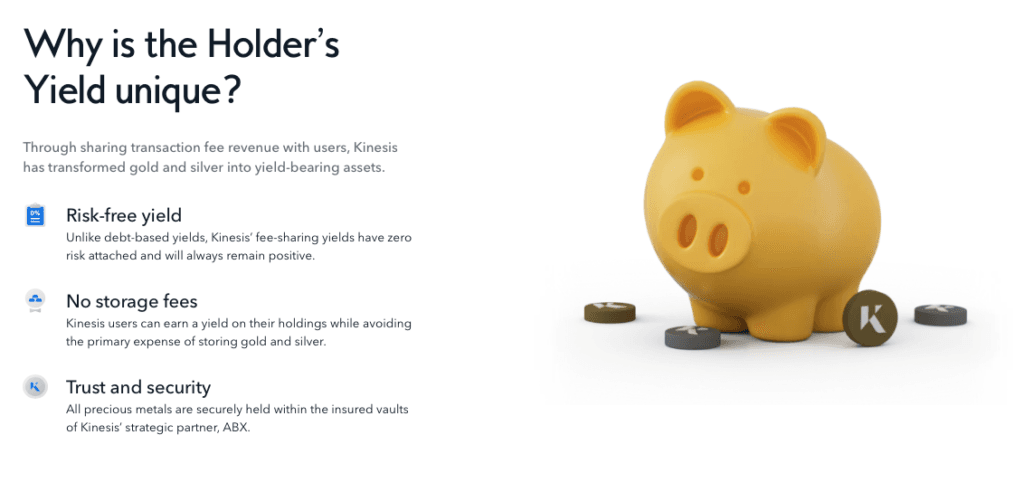
The Holder’s Yield distributes 15% of the Master Fee Pool to users who maintain balances of Kinesis gold (KAU) and Kinesis silver (KAG). These yields are paid monthly in the form of additional KAU and KAG. The underlying precious metals are held in allocated form within insured vaults operated by the Allocated Bullion Exchange, and users do not pay separate storage fees for this arrangement.
At first glance, the idea of earning a yield on gold or silver may seem to run against one of the most familiar principles of precious metals investing. Gold is generally regarded as an asset that preserves value rather than produces income. Yet the Holder’s Yield introduces a different mechanism: rather than generating a return through lending, interest payments, or financial leverage, it distributes a portion of transaction fees generated within the monetary system to those who hold its precious-metal currencies. The concept is not that gold itself has suddenly begun to pay interest. Rather, the monetary system built around the metal creates a source of revenue that can be shared with its holders.
“Gold Has No Yield”: The Traditional View Challenged
One of the more interesting aspects of the Holder’s Yield is the way it invites to reconsider what it means to earn a return from precious metals. Traditional ownership of physical gold has always involved a trade-off. The metal can be stored securely and held for the long term, but it does not ordinarily generate an income stream simply because it sits in a vault. In fact, “gold has no yield” is standard language in finance and investment analysis. Economists, analysts and financial journalists routinely describe gold as a non-yielding asset, meaning that gold bullion and gold investments in general, typically don’t produce interest, dividends, or coupon payments merely by being owned: a bond pays interest because the issuer borrows capital. A share may pay a dividend because the underlying company generates profits. A savings account pays interest because the bank puts deposited funds to use. A bar of gold, by contrast, simply remains a bar of gold.
The Holder’s Yield introduces another possibility without changing that fundamental characteristic of the metal. By combining allocated ownership of precious metals with an ongoing distribution of platform-generated fees, the Kinesis model provides one example of how gold and silver can participate in a contemporary monetary system while remaining tied to physical bullion. Crucially, the return does not depend on lending out the underlying metals or using them as collateral for leveraged positions. Instead, it comes from transaction fees collected across the platform. Holders therefore retain ownership of their allocated metals while receiving additional metal through the distribution mechanism.
This is materially different from many conventional forms of yield generation, where earning a return may require accepting additional counterparty, credit, lending, or leverage risk. In the Kinesis model, the source of the distribution is the activity and fees generated by the monetary system itself.
What Is Kinesis Holder’s Yield?
Kinesis Holder’s Yield is an incentive within the Kinesis Monetary System that rewards individuals and businesses for holding gold (KAU) or silver (KAG) in their Kinesis accounts or linked wallets. The basic principle is simple: users who maintain eligible balances can receive a share of the relevant yield distribution. Rather than being paid in fiat currency, the distribution is made in KAU or KAG. In practical terms, this means that holding precious metals within the system can produce an additional quantity of the same metal over time. A holder of KAU receives additional KAU, while a holder of KAG receives additional KAG. The mechanism is therefore designed not merely to encourage ownership of precious metals, but to encourage individuals and businesses to keep their gold and silver within a monetary ecosystem in which they are used to generate economic activity.
Benefits of the Holder’s Yield for Kinesis Users
Passive & Compounding Returns on Precious Metals
The most direct benefit is the possibility of receiving additional KAU or KAG simply by maintaining an eligible balance: there is no requirement to trade the metal, actively manage a position, or make repeated investment decisions in order to receive the distribution. Once the relevant conditions are met, the yield is paid periodically, allowing the holder to accumulate additional metal without making a separate purchase.
For someone who already intends to hold precious metals within the Kinesis system, this creates an additional source of return without requiring additional capital at the time of distribution. The distinction is subtle but important: the holder is not being asked to take on a new investment strategy simply to pursue the yield. The yield is connected to an existing holding. Over longer periods, successive distributions can also increase the quantity of metal held. In that sense, the mechanism introduces a compounding element to precious-metal ownership: each distribution adds to the underlying balance, which may then form part of the balance from which future distributions are calculated, subject to the applicable rules of the system.
No Storage Fees
Another feature of the Kinesis Monetary System is that participants do not incur the storage fees normally associated with allocated precious metals. This point is separate from the Holder’s Yield itself, but the two are connected through the system’s broader fee structure. The fee-sharing model that supports the Holder’s Yield also contributes to the payment of storage and insurance costs for the underlying bullion through the Master Fee Pool. For holders of allocated bullion, this creates an important distinction from conventional physical ownership. Someone holding gold or silver directly may have to account for vaulting, insurance, and related custody expenses. Within the Kinesis structure, those costs are incorporated into the monetary system’s fee model rather than being charged separately to the holder.
The result is a combination of two features: eligible holders can receive a yield on their precious-metal balances while avoiding the separate storage fees that would ordinarily accompany allocated bullion.
Yield Paid in Precious Metals
The form in which the yield is paid is perhaps the most distinctive part of the arrangement. Distributions are made in allocated gold and silver rather than in fiat currency or an unrelated financial asset. The additional amount therefore increases the holder’s position in the same monetary metal they already own: if one holds KAU, the distribution is made in KAU, if one holds KAG, it is made in KAG.
That may sound like a small distinction, but it changes the character of the return. Rather than receiving cash that must then be converted into gold or silver, the holder receives additional metal directly. There is no intermediate currency conversion required simply to maintain the same type of exposure. Over time, repeated distributions can therefore increase the holder’s metal balance without requiring additional purchases. For people who hold precious metals specifically because they want exposure to gold or silver, receiving the return in kind may also feel more consistent with the original purpose of the holding.
Long-Term Wealth Preservation
Because the yield is distributed in the form of additional metal, each payment increases the holder’s underlying position without requiring a fresh purchase. Over an extended period, those additions can accumulate and potentially compound, depending on the applicable distribution rules and future yields. This is different from receiving a conventional cash income from an investment. The holder is not converting the metal into an income-producing security. Instead, the reward remains within the precious-metal position itself. That distinction may be particularly relevant to those who view precious metals primarily as a means of preserving purchasing power over time. The yield allows the quantity of metal held to grow while maintaining exposure to the same underlying asset.
Portfolio Diversification
Precious metals are also commonly used as a means of portfolio diversification because their behaviour can differ from that of equities and fixed-income investments. Gold and silver do not always move in step with stock markets or bond prices. Their relationship with other asset classes can change considerably depending on interest rates, inflation expectations, monetary conditions, currency movements, and investor sentiment. For this reason, some investors use precious metals as one component of a broader portfolio rather than treating them as a substitute for every other asset.
The Holder’s Yield does not fundamentally alter the market characteristics of gold or silver. What it adds is another dimension to the holding: an investor is not simply holding an asset with its own price behaviour and risk characteristics. An eligible holder may also receive periodic additions to that position. Over time, this can affect the way the investor views the size and composition of a precious-metals allocation.
It is important, however, to distinguish between the yield mechanism and the market value of the underlying metal. Receiving additional KAU or KAG does not eliminate the possibility that the market price of gold or silver may rise or fall. The additional quantity and the market value of that quantity are separate considerations.
Ownership of Allocated Bullion
The question of what is actually owned sits at the heart of any discussion of precious-metals investment. KAU and KAG represent interests in specifically allocated physical bullion rather than a general entitlement to an unspecified pool of metal or an unbacked promise. This creates a direct connection between the digital representation held in the account and the physical gold or silver stored in vaults.
That distinction can matter considerably to investors who place importance on the underlying asset itself. There is a fundamental difference between owning an interest connected to identifiable physical bullion and holding a purely synthetic instrument whose value depends solely on the performance of an underlying reference price. Within the Kinesis structure, the yield is also delivered in the form of the relevant precious metal rather than as a derivative or synthetic substitute. A holder of KAU receives additional KAU; a holder of KAG receives additional KAG.
The result is a model in which the digital representation, the physical metal, and the yield mechanism are closely connected. For users who choose precious metals because they want direct exposure to gold or silver, rather than merely exposure to their price, that distinction is central to understanding what the Holder’s Yield is designed to provide.
Benefits of the Holder’s Yield for the Kinesis Monetary System
Participation Incentives
Offering a return on eligible holdings can give users a practical reason to bring their precious metals into the Kinesis system and keep them there. Rather than viewing the platform solely as a place to buy, sell, or transfer gold and silver, users may also consider it as an environment in which their existing holdings can generate an additional return. This creates a form of participation incentive that is directly connected to holding assets within the monetary system. The attraction is not simply the possibility of earning a return, but the prospect of doing so while continuing to hold exposure to the underlying precious metals.
Alignment of Interests
When a portion of platform fees is shared with users who maintain eligible balances, the rewards received by participants become connected to the economic activity of the system itself. In broad terms, greater activity generates fees, and those fees provide the source from which distributions can be made. This creates a relationship between the use of the monetary system, its ongoing economic activity, and the rewards available to its participants.
That structure differs fundamentally from debt-based yield models. In a conventional lending arrangement, the return is generally tied to an obligation: a borrower receives capital and is expected to repay it with interest. The central consideration is therefore the borrower’s ability to meet those obligations.
A fee-sharing model works differently. The return is not primarily compensation for lending capital to a borrower. Instead, it is derived from economic activity taking place within the system and shared with eligible holders. The interests of the platform and its participants are consequently linked in a different way: the sustainability and activity of the system are relevant to the pool from which rewards are distributed.
Encouraging Long-Term Commitment
Monthly distributions based on holdings can also encourage users to maintain their positions over time rather than moving their metals in and out of the system frequently: when a regular distribution is associated with the amount of KAU or KAG maintained within an account or linked wallet, there is an ongoing reason to keep those holdings within the ecosystem. This does not amount to a lock-up period, nor does it impose a penalty for withdrawing metals. Holders remain able to access or transfer their assets. The distinction is that maintaining a balance creates an additional economic incentive to remain within the system.
Why a Higher KAU and KAG Market Capitalisation Matters
At this point, an important question arises: why does the market capitalisation of KAU and KAG matter if the health of a monetary system is ultimately determined less by how many units are in circulation than by how actively those units are used?
There is considerable truth in this distinction. Market capitalisation alone does not tell us how frequently KAU or KAG changes hands, how many transactions take place, or how effectively the currencies function as a medium of exchange. In monetary terms, velocity—the rate at which units circulate through the economy—can be more informative than the absolute value of the units in existence. Even so, a higher market capitalisation can provide several indirect advantages for the Kinesis Monetary System.
Improved Liquidity and Market Depth
A larger market capitalisation is generally associated with a deeper market, although the relationship is not automatic. Greater depth can mean tighter spreads and a greater capacity to absorb substantial trades without causing disproportionate price movements. This can make a market more practical for larger users and institutions, whose transactions may be considerably greater in size than those of individual participants. If greater liquidity attracts more participants, that additional participation can, in turn, support higher and more sustained transaction volumes. Market capitalisation is therefore not a substitute for liquidity or transaction activity, but it can form part of the foundation on which a deeper market develops.
Signalling and Network Effects
Market size can also act as a visible signal of scale. A larger market capitalisation may suggest that a monetary network has accumulated a substantial base of users and capital and has achieved a degree of continuity. For prospective merchants, payment providers, and other participants, that perception of established scale can matter when deciding whether to integrate with a system.
This is where network effects become relevant. A system becomes more useful as more people and businesses are able to use it. Greater visibility may attract additional participants; additional participants can create more opportunities for transactions; and greater transaction activity can, in turn, strengthen the usefulness and visibility of the network. Market capitalisation does not create those network effects by itself, but it can contribute to the perception of scale that helps them develop.
Collateral and Partnership Considerations
Market size can also enter into the assessments made by external counterparties. Card networks, custodians, liquidity providers, commercial partners, and regulators may consider the overall scale of a monetary system when evaluating its operational significance, commercial viability, or risk profile. A larger market can therefore provide a stronger basis for discussions with institutions that are considering whether, and on what terms, to work with the system.
This does not mean that market capitalisation determines whether such relationships are possible. Operational standards, regulatory requirements, liquidity, governance, technology, and many other factors remain important. Rather, a substantial market can provide useful evidence of scale when those external relationships are being assessed.

Eligibility Criteria
To qualify for the Holder’s Yield, users must hold Kinesis gold (KAU) or Kinesis silver (KAG) within their Kinesis account or a linked wallet. Only metals that remain within the Kinesis ecosystem are considered eligible. If holdings are moved outside the system, those holdings no longer count toward the yield calculation for the relevant period. Other assets held in a Kinesis account do not generate the Holder’s Yield.
There are several ways to acquire eligible KAU or KAG: a) Minting, i.e. creating new KAU or KAG through the Kinesis system; b) purchasing, i.e. buying KAU or KAG directly through the Kinesis platform; c) receiving Transfers, i.e. accepting KAU or KAG transferred from another user; and d) earning Rewards, i.e. receiving KAU or KAG through a previous yield distribution. Regardless of how the metal entered an account, the key consideration for eligibility is whether the KAU or KAG remains within the relevant Kinesis environment during the measurement period.
Daily Accrual and Holding Periods
Users do not need to hold KAU or KAG for an entire calendar month to qualify for the Holder’s Yield. Instead, the yield accrues on a daily basis according to the amount of KAU or KAG held and the number of days those holdings remain within their account or linked wallet. The resulting distribution therefore reflects both the size of your eligible balance and the length of time that balance was maintained during the month.
This daily approach provides greater flexibility than a system based solely on a month-end snapshot. Someone who acquires KAU or KAG partway through a month can still accrue a yield for the eligible days during which the metal was held. Likewise, if holdings change during the month, the calculation can account for those changes rather than treating the entire period as though the same balance had been maintained throughout.
In this sense, the mechanism is designed to match the distribution more closely to the actual amount of eligible metal held over the relevant period.
Calculation and Distribution Process
Once eligibility has been established, the distribution follows a proportional model. Each month, the total yield pool—funded from a designated portion of the Master Fee Pool—is distributed among eligible account holders. One’s share depends on the amount of KAU or KAG held relative to the total eligible holdings across the participating system. The principle is therefore one of proportional ownership. A holder with a larger eligible balance receives a larger share of the available pool, while a holder with a smaller balance receives a correspondingly smaller share.
The distribution is not a flat payment, and it is not determined by how frequently users trade or how many transactions they make. The relevant factor is the proportion of eligible holdings attributed to their account during the applicable measurement period.
Once the calculation has been completed, the system credits the resulting yield directly to the account. Gold holders receive their distribution in KAU, while silver holders receive theirs in KAG. The distribution operates on a monthly cycle according to the platform’s established schedule. No separate action is required from the holder to receive an eligible payment.
Payment Details
Currency of Payment
The currency of the payment corresponds to the precious metal being held. Kinesis gold eligible gold holdings receive the Holder’s Yield in KAU and eligible silver holdings receive the Holder’s Yield in KAG. The result is a payment made in kind. Rather than receiving a fiat-currency equivalent, the holder receives additional units representing the same underlying precious metal.
Frequency of Payments
Payments are made monthly, typically within the first week of the following month. Each distribution covers the yield accrued during the preceding calendar month. The timing therefore separates the period during which the yield is earned from the subsequent period in which it is calculated and distributed.
Distribution and Monitoring
Earned yields are deposited directly into the user’s Kinesis account. Kinesis tracks eligible KAU and KAG holdings across the account and any linked wallets included within the relevant framework. This allows the calculation to reflect holdings maintained in the locations recognised by the system. Users can monitor their earnings and related activity through the Yield Dashboard on the Kinesis platform. The dashboard provides an overview of the rewards associated with their eligible holdings and allows users to follow the development of their yield over time.
Automatic Participation
Participation in the Holder’s Yield is automatic. There is no separate requirement to opt in, stake tokens, or lock precious metals away for a predetermined period. As long as eligible KAU or KAG balances remain within the relevant account or linked wallet during the measurement period, they are included in the monthly calculation. This removes the need for users to remember enrolment dates, submit individual claims, or take recurring action to participate. The mechanism is instead built into the normal process of holding eligible precious metals within the Kinesis ecosystem.
The broader effect is to make the Holder’s Yield a feature of participation rather than a separate investment product. Users continue to hold their gold or silver, retain access to their balances, and, provided the relevant eligibility requirements are met, participate automatically in the distribution of the designated portion of system-generated fees.