
Table Of Contents
The Gold Standard Of E-Commerce Payments
Kinesis Pay is the dedicated merchant payment rail that gives the Kinesis Monetary System a practical role in everyday commerce, extending it beyond its established functions as a store-of-value and peer-to-peer platform.
The application advances Kinesis’ broader monetary proposition by giving businesses a free, native means of accepting the same assets already available within the system: gold, silver, Currency One stablecoins, KVT, and more than 40 digital assets, including BTC, ETH and XLM. In practical terms, this means a merchant can accept payment in assets that customers already hold, whether the transaction takes place online or in a physical store.
Every payment adds to the overall velocity of the system and, in turn, contributes to the fee pool from which monthly yields are funded, including Holder’s Yield for merchants who retain their KAU or KAG. The significance is therefore broader than the payment itself. Merchant activity brings precious-metal-backed money into ordinary economic transactions, where it can circulate rather than simply sit in a savings or trading account.
Without a scalable merchant-acceptance layer, Kinesis remains largely a platform for holding and trading assets. Kinesis Pay adds the missing commercial function: it gives those assets a direct role as money used to buy goods and services.
Integration within the Kinesis Monetary System
Kinesis Pay operates entirely within the Kinesis Monetary System. Transactions settle near-instantly on the Kinesis blockchain, which is based on Stellar technology, with no minimum transaction amount and, at present, no fees for either the merchant or the customer.
For a business, the process begins with the creation of a free Merchant profile within its Kinesis account. The merchant can then download the relevant software development kit, with WooCommerce currently serving as the primary integration for online stores, and begin accepting payments.
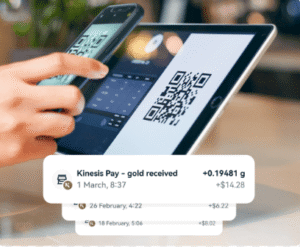
Customers can complete a payment by scanning a QR code through the Kinesis application or by approving a payment ID on desktop. The selected asset moves directly from the buyer’s Kinesis balance to the merchant’s account. Card details are not exchanged, and settlement remains within the Kinesis ecosystem rather than passing through a conventional card network.
There is also an economic incentive for merchants that choose to retain the gold or silver they receive. KAU and KAG balances held within the Kinesis system qualify merchants for Holder’s Yield, while businesses that refer other merchants can receive a share of the associated fees.
The result is a payment mechanism that fits into the wider economics of Kinesis rather than operating as a separate layer. The same fee-pool structure that rewards holders, spenders and referrers elsewhere in the system also applies to merchant activity. In principle, this creates a reinforcing cycle: greater merchant acceptance encourages more transactions, higher transaction activity enlarges the fee pool, and the resulting distributions provide an additional incentive for continued participation.
Connection to the Merchant Directory
The Merchant Directory serves as the public discovery layer surrounding Kinesis Pay. It is a free, searchable hub available through the Kinesis website and within the platform, where users can find verified businesses that accept gold, silver, stablecoins and digital assets through Kinesis Pay.
Merchant profiles can include a website, physical location, business category, opening hours, social-media links and a description of the business. Users can narrow their searches by country, store type—online or physical—or category.
This gives Kinesis holders a straightforward way to identify businesses where their assets can actually be spent. For merchants, the Directory offers visibility among an audience already familiar with alternative forms of money and potentially interested in using them for ordinary purchases.
In summary, the Directory helps users find participating merchants, while those merchants provide additional places in which Kinesis assets can circulate. More points of acceptance, in turn, can contribute to greater transaction activity within the system and support the mechanisms through which yields are generated.
Relationship with the Kinesis Card
Kinesis Pay and the Kinesis Card are better understood as complementary payment channels than as competing products.
The Card is designed to bridge the Kinesis ecosystem and the conventional payments economy. It can convert KAU, KAG, Currency One or supported cryptocurrencies into local fiat currency at the point of sale, wherever the relevant Mastercard or Visa network is accepted. Features such as cashback in gold and contributions to the fee pool add further connections to the wider Kinesis system.
Kinesis Pay takes a different approach. Instead of converting the customer’s asset into fiat and sending the payment through a conventional card network, it keeps the transaction within the Kinesis ecosystem. The merchant receives the selected asset directly, settlement is near-instant, and the payment itself carries no transaction fee.
The distinction gives users two practical routes into commerce. The Card provides broad acceptance wherever conventional card payments are supported; Kinesis Pay provides a native Kinesis payment rail for participating merchants, allowing gold, silver and supported digital assets to move directly between buyer and seller.
Together, the two channels address different parts of the same problem: how assets held within Kinesis can move from being stores of value into actual spending instruments, both inside the Kinesis network and throughout the wider economy.
Kinesis Pay for Businesses
Who Can Use It
Kinesis Pay is designed to accommodate businesses of different sizes, from individual sole traders and small vendors to larger companies and multinational firms. There is no stated size restriction preventing a business from participating.
That broad eligibility matters because a payment network becomes more useful as its merchant base becomes more diverse. A system that can accommodate a small independent seller as readily as a larger commercial operation has the potential to develop across different sectors rather than being confined to a single type of merchant.
Setup and Management
Businesses can establish their merchant profile through the Merchant section of their Kinesis account. There is no cost to create the profile, and the setup is intended to avoid the kind of technical complexity that can discourage smaller businesses from adopting a new payment method.
Once the profile is active, merchants can begin accepting KAU and KAG, Kinesis’ gold- and silver-backed digital assets. The available plugin is designed to be straightforward to install and does not require specialist technical knowledge. It can be downloaded and configured on common e-commerce or point-of-sale systems without the need for outside technical support.
The merchant dashboard also provides tools for viewing and analysing transactions, giving businesses a way to monitor payment activity and assess how the system is performing within their operations.
Currency Options
Transactions on Kinesis Pay are carried out using KAU, KAG, the Kinesis Velocity Token (KVT), one of the Currency One stablecoin suite, or any of the digital assets available on the Kinesis platform.
Merchants also have the ability to select a preferred fiat currency, such as euros or US dollars, for display purposes when configuring their account.
Benefits for Businesses
Alternative Payment Option
Accepting gold- and silver-backed digital currencies gives customers an alternative to conventional fiat payments. This is particularly relevant to buyers who deliberately seek asset-backed money as a way of diversifying their holdings or protecting against concerns about inflation and monetary instability.
For a merchant, placing Kinesis Pay alongside existing payment methods does not require customers to abandon the methods they already use. Instead, it expands the range of payment choices available at checkout. It may also appeal to a specific and potentially growing group of consumers who already hold precious metals within the Kinesis system and would prefer to spend those assets directly rather than converting them into fiat first.
In that sense, Kinesis Pay is less about replacing conventional payment methods than about giving businesses another channel through which to serve a particular segment of customers.
Cross-Border Capability
Merchants operating in different countries can accept the same gold- and silver-backed assets directly. Because transactions settle on the Kinesis blockchain rather than passing through correspondent banking networks, some of the familiar complications of international payments—currency-conversion mark-ups, intermediary banking charges and multi-day clearing periods—can be reduced or removed. A customer in one jurisdiction can therefore pay a merchant in another using digital units representing physical gold or silver, with settlement taking place near-instantly.
For companies that sell internationally or maintain a geographically dispersed customer base, this can simplify the movement of funds and reduce some of the friction associated with conventional cross-border payment arrangements.
Cost-Free Installation and Usage
There are no setup fees, monthly charges or per-transaction processing fees for merchants using Kinesis Pay. Creating the Merchant profile and installing the available SDK, which currently focuses on WooCommerce for online commerce, are both free. Once the system is operational, incoming payments settle without the percentage-based processing charges associated with conventional card networks. Card-processing costs commonly represent a meaningful expense for merchants, particularly businesses operating with narrow margins or substantial transaction volumes.
A zero-fee payment rail can therefore be commercially relevant even before considering its other characteristics. The importance of the saving will vary from one business to another, depending on its existing payment costs, sales volume and the proportion of customers who ultimately choose Kinesis Pay.
Digital Finance Alignment
Accepting precious-metal-backed digital assets also places a business within the broader development of digital finance and alternative monetary systems. The commercial effect will naturally differ according to the business, its market and the preferences of its customers. Nevertheless, the payment method may appeal to consumers who place particular value on transparency, asset backing and alternative financial infrastructure.
For some merchants, that alignment can become part of their differentiation. It does not guarantee additional sales, but it can communicate a clear position to customers who are interested in forms of money that sit outside conventional banking and payment structures.
Reduced Processing Delays
Kinesis Pay does not depend on traditional bank-processing cycles in the same way as a conventional card transaction. Once a customer confirms a payment through the QR code or payment ID, settlement takes place near-instantly on the Kinesis ledger. The distinction becomes particularly relevant in international commerce, where bank transfers and some card transactions can involve authorisation periods, clearing delays or uncertainty over when funds will become available.
Faster settlement can improve cash-flow visibility. Instead of waiting for receivables to clear over several business days, a merchant can receive the relevant asset directly through the Kinesis system once the payment has been confirmed.
Historical Value Preservation
Gold and silver have historically been regarded as stores of value over long periods and have, at various points, preserved purchasing power during periods when fiat currencies experienced sustained inflation or monetary expansion. When a merchant receives KAU or KAG and chooses to retain those balances, its revenue is consequently held in units linked to precious metals rather than being immediately converted into a national currency. That does not eliminate market risk: the value of gold and silver can fluctuate, and their prices can fall as well as rise. But their historical characteristics provide a fundamentally different exposure from holding a single fiat currency, particularly over longer periods.
For businesses concerned about the erosion of purchasing power in cash balances, this can serve as one reason to consider retaining a portion of operating funds in precious-metal-backed assets.
Reduced Currency Exposure
Holding a portion of sales proceeds in gold and silver can also reduce a company’s dependence on a single national currency or monetary system.
For businesses operating across several jurisdictions, exposure to exchange-rate movements is a normal part of international commerce. Additional risks can arise from capital controls, banking-sector stress or significant changes in the value of a local currency. Diversifying working capital into precious-metal-backed assets can provide another form of monetary exposure without requiring the business to construct a conventional currency-hedging programme.
The benefit is not that currency risk disappears, but that the business is no longer relying exclusively on the stability of one monetary regime.
Holder’s Yield
Merchants that retain the KAU or KAG they receive within their Kinesis accounts become eligible for the monthly Holder’s Yield. This distribution is funded from a share of transaction fees generated across the Kinesis Monetary System and is paid in physical gold and silver according to the amount of metal held.
Because the yield is denominated in the same asset-backed units, it differs from a conventional return expressed solely in fiat currency. The underlying economic exposure remains connected to gold or silver rather than being entirely dependent on the purchasing power of a paper currency.
For a merchant, the mechanism potentially turns a portion of otherwise idle operating capital into a yield-bearing reserve while leaving those assets available for future spending or redemption.
Referrer’s Yield
Businesses can also participate in the Kinesis referral structure by introducing other merchants or clients to the system. When a referred participant generates transaction activity, the referring business receives 7.5% of the associated fees. This creates a secondary source of income that can expand as the referred network becomes more active.
The structure is intended to align the interests of existing merchants with the expansion of the broader network. A business that introduces another merchant does not merely receive an incentive for the initial referral; its economic interest can continue as the referred participant generates qualifying transaction activity. In this way, merchant referrals become another mechanism through which participation in the wider Kinesis economy can be rewarded.
Kinesis Pay for Customers
The Checkout Experience
For customers, Kinesis Pay appears as a payment option at participating online stores. The process is deliberately familiar. At checkout, the customer scans a QR code using the Kinesis mobile application, reviews the payment and confirms the transaction. Payment is made directly in KAU or KAG, and the customer does not need to provide card details to the merchant.
For people who do not yet hold Kinesis assets, the system also represents an introduction to the idea of making purchases with precious-metal-backed digital money. The appeal rests partly on the characteristics traditionally associated with gold and silver: scarcity, long-term store-of-value properties and a monetary history extending far beyond modern fiat currencies.
Customer Benefits
No Card Details Are Transmitted During Transactions
When a customer pays through Kinesis Pay, card numbers, CVV codes and bank credentials are not transmitted to the merchant or stored on the customer’s device as part of the payment process. Instead, an encrypted QR code or payment identifier is generated and authorised through the customer’s own Kinesis account. This changes the nature of the information exchanged during the transaction. Rather than handing sensitive card credentials to a merchant, the customer authorises a payment from within the Kinesis environment.
That can reduce the amount of card-related information exposed during an online purchase and consequently reduce certain risks associated with card-data theft or skimming, particularly when buying from a merchant with which the customer has little previous experience.
No Currency Conversion Is Required at the Customer’s Side
The customer selects an asset already held in the Kinesis wallet, typically KAU or KAG, and confirms the payment, the required amount of KAU or KAG is then automatically calculated to match the exact fiat value of the product at the time of purchase. There is therefore no need to convert into the local fiat currency at the point of purchase.
For users who deliberately hold precious metals as part of their financial strategy, this allows the same unit of account to be used for spending rather than requiring an intermediate conversion into conventional currency.
Payments Are Made in Asset-Backed Digital Currencies
For customers who already hold precious metals within the KMS, paying with these units can therefore be viewed as an extension of an existing holding strategy. Instead of selling the asset for fiat currency and then using the fiat proceeds to make a purchase, the customer can spend the asset directly where Kinesis Pay is accepted.
The distinction is important because the transaction is not simply a cryptocurrency payment in the conventional sense, as the digital units are linked to physical precious metals and derive their monetary characteristics from those underlying assets.
The QR-Based Payment Flow Is Familiar to Users of Other Digital Wallets
The customer journey closely resembles QR-based payment systems already used by digital wallets and mobile-payment applications around the world: the merchant displays a QR code. The customer scans it using the Kinesis application, checks the amount and selected asset, and authorises the transaction.
That familiarity reduces the amount of new behaviour required from the customer. Someone already comfortable with mobile wallets can understand the basic process immediately, which can help reduce friction for first-time users. At the point of sale, simplicity matters. A payment method may have an interesting underlying monetary architecture, but customers are unlikely to adopt it widely if the act of paying is unnecessarily complicated.
Buyers Pay No Fees When Making Purchases with KAU or KAG
Customers do not pay a transaction fee when purchasing with KAU or KAG through Kinesis Pay. The amount corresponding to the purchase is transferred without the percentage-based payment charge associated with many conventional card networks and cryptocurrency payment gateways.
That makes the payment rail potentially attractive for both small everyday purchases and larger transactions. The absence of a direct payment fee removes one of the simplest economic objections a customer might otherwise have to using an alternative payment method.
Costs for Using Kinesis Pay
For merchants, Kinesis Pay does not impose a processing fee on each transaction. There are also no monthly charges or installation costs associated with the payment plugin. Customers likewise pay no transaction fee when purchasing with KAU or KAG.
From a merchant’s perspective, this places the direct cost structure in contrast with traditional card networks, where a percentage of each sale is typically deducted to cover payment processing.
That comparison should nevertheless be made carefully. A payment system can be free to use while still involving other economic considerations. One such consideration is the spread between buying and selling prices for the underlying precious metals. That spread can influence the effective exchange rate when a user moves between fiat currency and digital precious-metal tokens. These costs are not transaction fees charged by Kinesis Pay itself. Rather, they are part of the economics of buying and selling an asset-backed digital currency and therefore need to be considered separately when evaluating the overall cost of using the system.
Wider Payment Context
Online commerce continues to expand, with worldwide online sales having surpassed $5 trillion in recent annual estimates. At the same time, an increasing proportion of digital commerce is conducted through payment methods other than traditional cards. In some markets, mobile wallets and QR-based payment systems already account for more than half of digital retail payments. Conventional card networks, meanwhile, commonly impose merchant processing costs in the region of 1.5% to 3% of a transaction, with costs potentially rising for cross-border transactions or transactions considered higher risk.
Against this backdrop, Kinesis Pay’s cost structure is one of its more readily identifiable points of difference. Installation is free, and neither merchants nor customers pay a fee for the transaction itself.