

Table of Contents
Comparing Debt-Based and Commerce-Based Sources of Yield
The Kinesis Monetary System is built around a simple principle: wealth should be generated through genuine economic activity rather than through debt creation or the continual inflow of new capital. This principle underpins the platform’s revenue model and yield structure, setting Kinesis yields apart from traditional forms of investment income such as bank interest, bond coupons, and corporate dividends.
The economic model underlying the Kinesis Yield System is not new. It resembles centuries-old cooperative and mutual structures, where members and users participate in and are rewarded from the proceeds generated by the organisation’s economic activity. The yield is simply a redistribution of actual network transaction fees to participants.
Current Money Supply is Largely Debt-Based
The current financial system is often described as debt-based because most of the money in modern economies is created as debt, mainly by commercial banks when they extend loans: when someone deposits money in a bank, the bank does not usually leave those funds idle. It lends them out in the form of mortgages, business loans, credit-card balances or personal loans. When a commercial bank grants a mortgage or a business loan, it does not transfer existing money from another customer’s account. It simply credits the borrower’s account with new numbers. At that moment new money comes into existence. In short, the money is created out of debt.
The same process occurs whenever individuals, companies or public bodies borrow from banks: the act of lending itself expands the money supply. A parallel mechanism operates at the sovereign level: when a government issues Treasury bonds (IOUs) and sells them to the central bank, the central bank creates new base money to purchase those bonds.
In each of these cases it is not that money itself is debt; rather, the money is brought into existence through the creation of debt. Tying money supply to physical precious metals addresses this debt-based method of money creation.
Debt as the Major Source of Financial Returns
For the purpose of understanding Kinesis yields, the more relevant question is not how money is created, but how investment returns are generated. Traditional finance is also debt-based in the sense that investment income originate from debt.
Consider a simple savings account. The interest paid to depositors does not appear out of nowhere. Banks are generally able to pay that interest because they lend money to borrowers at higher rates than they pay to depositors. The depositor’s return is therefore financed by someone else’s debt.
The same principle runs through the wider financial system. Companies raise capital by issuing corporate bonds, governments borrow by issuing sovereign bonds, municipalities finance public projects through debt securities, and many investment funds earn returns by holding these instruments. Pension funds, insurance companies and asset managers collectively invest trillions in debt markets because the interest payments provide a relatively predictable stream of income.
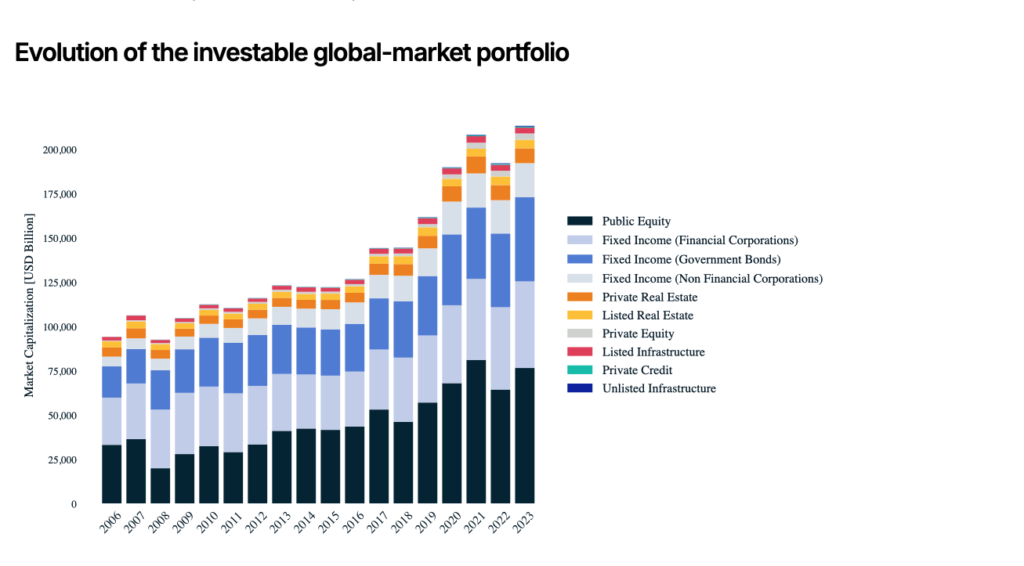
Debt is no longer merely one component of the economy; it has become one of the principal mechanisms through which financial returns are produced. According to MSCI, the debt market has continuously held the largest share of the investable global-market portfolio over the past two decades.
Returns Generated by Economic Activity
Instead of lending users’ assets, the platform generates revenue from economic activity promoting through money velocity: KAU and KAG transfers produces fees which accumulate in the Master Fee Pool, from which the various yields are paid. No debt is created in the process of generating these returns.
While in a debt-based system, returns depend largely on borrowers meeting future repayment obligations, in an activity-based system, returns depend on the volume of transactions. Revenue is linked to commerce rather than to credit creation: when economic activity rises, the distributions rise; when it slows, the distributions fall. Participants receive returns not as creditors but as participants within an economic system. Returns depends on creating wealth (by moving money) rather than on simply lending out capital.