
Table Of Contents
The User’s Yield: Getting Rewarded with the Velocity Yield for Using Sound Money
The Velocity Yield is designed to support the circulation of sound money within the KMS. It addresses the tendency, sometimes linked to Gresham’s Law, for people to hold onto higher-value money while spending lower-value forms. This pattern has historically been noticeable with precious metals. The yield provides a return based on active use—spending or trading—rather than only on holding balances, that’s why I call it the user‘s yield.
How the Velocity Yield Works
Users become eligible for the Velocity Yield when they spend or trade Kinesis gold (KAU) and silver (KAG) on the platform. The yield consists of 10% of the global transaction fees collected in the Kinesis Master Fee Pool for the month. These fees are then distributed to participants according to their qualifying activity.
The approach focuses on economic participation—spending and exchanging the metals—rather than passive storage alone. This structure aims to support liquidity in the system by tying returns to actual movement of value between users, merchants, and traders.
Benefits of the Velocity Yield Program
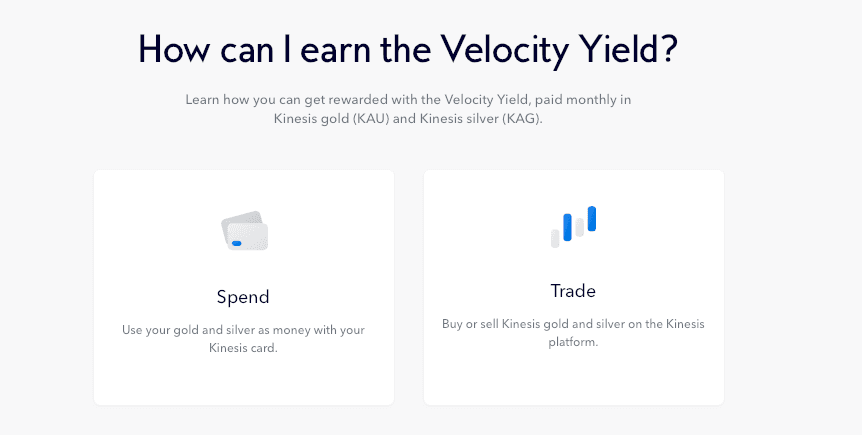
When users make purchases with the Kinesis card using KAU or KAG, they can receive additional gold or silver through the yield. Similarly, transactions on the Kinesis Exchange involving gold and silver pairs contribute to eligibility, resulting in distributions of precious metals based on activity.
The yield applies to situations where gold and silver are used in transactions rather than kept solely as long-term holdings. This means that spending and trading are treated differently from simple storage, which is the main distinction from the Holder’s Yield. Higher levels of spending and trading can lead to greater overall transaction volume, which in turn affects the size of the fee pool available for distribution across all yield categories.
Over time, regular use of KAU and KAG for payments or trades can slowly add to a user’s metal balances through the monthly yield payments. This accumulation happens using funds already involved in normal financial activity, which means it does not require additional capital beyond what the user is already spending or trading.
How is the Velocity Yield Calculated and Distributed
The Velocity Yield is distributed according to each participant’s level of activity within the Kinesis system.
Monthly Payments: Calculations are performed each month, with payments issued in Kinesis gold (KAU) for gold-related activity and Kinesis silver (KAG) for silver-related activity.
Proportional Reward: The share a user receives depends on how much they contribute to transaction activity relative to other participants. Higher personal usage generally results in a larger portion of the available yield.
Activity-Based Allocation: The distribution is tied directly to the volume and type of qualifying transactions each user completes, aligning rewards with the actual economic activity they generate on the platform.
Paid in Precious Metals: All distributions are credited directly as additional KAU or KAG, which adds to the user’s existing holdings of allocated bullion.
Encouraging Economic Growth and the Importance of Monetary Velocity
Kinesis allocates 10% of the Master Fee Pool to the Velocity Yield. This portion is distributed to users based on their spending and trading of gold and silver, with the aim of supporting the role of these metals as circulating currencies rather than assets held only for storage.
Monetary velocity describes how quickly money moves through an economy—how often the same unit changes hands over a given period. The Velocity Yield is one mechanism intended to influence this dynamic within the Kinesis Monetary System by linking returns to the frequency of use. Similar ideas appear in other areas of everyday finance. Cashback programs on credit cards return a portion of spending to the cardholder, lowering the effective cost of purchases. Frequent-flyer schemes in aviation award points or miles for travel, which can be used for future trips or upgrades. In both cases, routine activity generates additional value for the participant. The main difference with the Velocity Yield is that it draws from a pool of transaction fees generated across the Kinesis platform, rather than from merchant fees or separate marketing allocations.
Kinesis Velocity Yield: FAQ
What is the purpose of the Velocity Yield?
The Velocity Yield is a mechanism on the Kinesis platform designed to support the use of gold and silver as working currencies instead of assets held solely for long-term storage. It does this by providing returns to users who actively move or spend these currencies, which helps increase their circulation within the system.
How do I qualify?
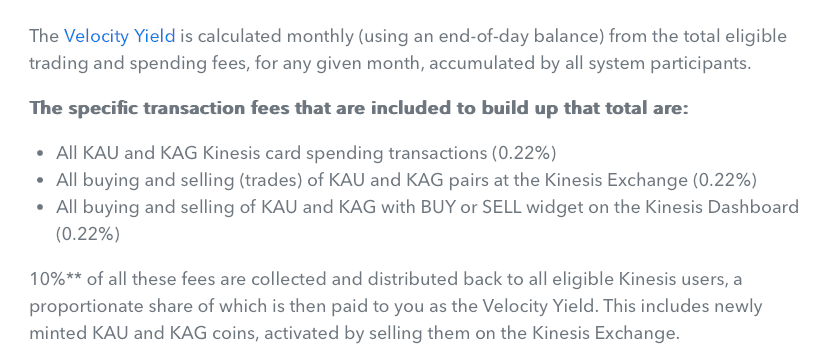
To receive the Velocity Yield, users must carry out transactions that involve Kinesis gold (KAU) or Kinesis silver (KAG). The main qualifying activities are trading on the Kinesis Exchange, such as exchanging KAU for XRP or KAG for BTC; buying or selling KAU and KAG directly through the BUY or SELL widgets available on the Kinesis Dashboard; and making purchases with the Kinesis debit card, either online or in stores, where the payment is drawn from KAU or KAG balances. These types of actions are what trigger eligibility for the yield each month.
Can I earn multiple yields for the same activity?
It is possible to qualify for more than one yield on related activities. For example, when a user mints new KAU or KAG and then later sells or transacts with those same units on the platform, they can receive the Minter’s Yield, which applies to the initial creation of the currencies, and the Velocity Yield, which applies to the subsequent trading or spending of those minted units. This structure allows both the production and the active use of KAU and KAG to generate returns where the activities overlap.
In what currency is the Velocity Yield paid?
The Velocity Yield is paid separately for gold and silver activity. The gold yield is based on eligible transactions involving KAU, including sending, spending, or related minting activity. The silver yield is based on eligible transactions involving KAG, including sending, spending, or related minting activity. All payments are made in KAU and KAG themselves.
Which transactions are eligible?
The Velocity Yield applies only to transactions that directly involve Kinesis gold (KAU) or Kinesis silver (KAG). This covers trades between KAU and KAG pairs on the exchange, as well as spending and transfers of these assets. Transactions involving other cryptocurrencies or fiat pairs—e.g. BTC/USD or XRP/EUR—are not included.
When and how are payments made?
Velocity Yield distributions occur once per month, typically during the first week of the month following the activity period. The amounts are deposited straight into the user’s Kinesis account. Each payment covers all qualifying activity from the previous calendar month.