

Table of Contents
- Gold & Silver Investing: A Comprehensive Guide
- Gold & Silver Tokens: Allocated Bullion in Digital Form
- Pros
- 24/7 trading and on-chain transferability
- Backed by physical gold with attestations
- No traditional storage or insurance fees for the holder
- Potential DeFi composability and self-custody options
- Allocated ownership
- Fractional ownership and high divisibility
- Potential monetary use
- No need for personal bullion storage
- Easy accessibility
- Yields
- Cons
- Pros
- If You Don’t Hold It, You Don’t Own It: Home-Held Physical Gold and Silver bullion
- Gold and Silver-Backed ETFs: Convenient Price Exposure
- Bank Products, Derivatives and Options: Exposure Without Bullion
- Allocated (Vaulted) Bullion
- Unallocated Gold and Silver Accounts
- Gold and Silver Futures contracts
- Gold and Silver Mining Stocks
- Conclusion: Gold is Gold—or is it?
- Gold & Silver Tokens: Allocated Bullion in Digital Form
Gold & Silver Investing: A Comprehensive Guide
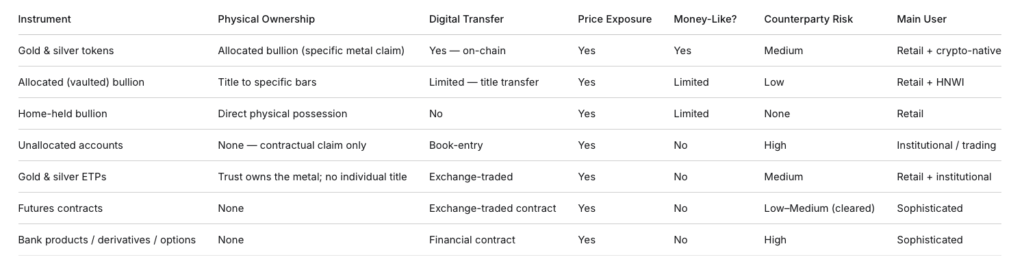
Gold and silver can be accessed in very different ways. An investor can buy and hold physical bullion, purchase allocated bullion stored in a professional vault, invest through a gold or silver exchange-traded product (ETP), trade bank-issued derivatives linked to precious-metal prices or gold and silver futures contracts, or use digital representations of allocated bullion like blockchain-based tokens.
Although all of these approaches can provide exposure to the value of gold or silver, they are fundamentally different in terms of ownership, custody, liquidity, counterparty risk, legal rights, and practical usability.
Considering these aspects makes the comparison more interesting than simply asking which product offers the best way to profit if the price of gold or silver rises – which unfortunately is the question that dominate these comparisons.
By considering all these aspects, the discussion opens itself up to questions which in my view are much more fundamental: what does the investor actually own, who holds the underlying asset, and what can the investor do with it?
Gold & Silver Tokens: Allocated Bullion in Digital Form
The concept underlying bullion tokenization is simple: digital units represent ownership of allocated physical metal, blending the security of vaulted bullion with the transferability — and potentially the spendability — of a digital asset. Imagine owning a precise slice of a gold bar sitting in a high-security vault, yet being able to send it across the world in seconds with a few taps on a phone. Gold and silver tokens turn allocated physical metal into blockchain units. Each token typically stands for a fixed weight of real bullion held under the issuer’s custody, often with serial-number tracking and regular attestations. Unlike a coin in your safe or a share on a stock exchange, these digital units live on public ledgers, trade around the clock, and can move between wallets without banks or brokers. They sit somewhere between classic vaulted metal and pure financial paper: the gold is meant to be there, but your day-to-day experience is entirely digital. The metal itself is ring-fenced from the issuer’s balance sheet, so if the platform fails, the bars remain yours (at least so goes the theory).
Pros
24/7 trading and on-chain transferability
Positions can be bought, sold or moved between wallets at any time, independent of traditional market hours or banking cut-offs, using blockchain settlement. This enables near-instant settlement and remote transfer, something impossible with metal sitting in a personal safe.
Backed by physical gold with attestations
Leading tokens claim one-to-one backing by London Good Delivery or equivalent bars held in vaults, with periodic independent attestations of reserves.
No traditional storage or insurance fees for the holder
Ongoing vaulting costs are absorbed by the issuer; the token holder typically pays only network gas fees and any creation/redemption spreads.
Potential DeFi composability and self-custody options
Tokens can be used as collateral in decentralised protocols or withdrawn to a self-custodial wallet, giving users greater control than conventional brokerage holdings.
Allocated ownership
Gold and silver tokens are structured so that each digital unit represents the blockchain-based record of ownership of a specific quantity of physical gold or silver held in allocated form in professional vaults. This means the holder has legal titel on identifiable metal rather than a general unsecured claim against a company’s balance sheet or a pooled, unallocated account.
Fractional ownership and high divisibility
Digital units can be split into very small fractions, allowing precise payments or transfers of tiny amounts of gold or silver. Physical coins and bars cannot be divided without melting or cutting, which is impractical and costly for everyday use.
Potential monetary use
Beyond simple investment exposure, gold and silver tokens (like KAU or KAG) can be designed to function as a medium of exchange, aiming to serve as digital money rather than pure investment or speculative assets.
No need for personal bullion storage
Owners avoid the practical burdens of keeping physical metal at home or in a private vault, including security systems, insurance arrangements, and the risk of damage or theft of the actual bars or coins.
Easy accessibility
Buying, selling, or transferring can typically be done through online accounts or apps with far less friction than sourcing, authenticating, transporting, and storing physical bullion through dealers or private sales.
Yields
One can earn a yield by depositing tokens into third-party crypto lending platforms or decentralized finance (DeFi) liquidity pools, or—as with Kinesis KAU and KAG—as rewards for using them
Cons
Minimums for physical redemption
Redeeming for actual bars usually can require hundreds of ounces (often a full London Good Delivery bar), rendering physical delivery impractical for most retail holders.
Potential tracking deviations or liquidity premia/discounts
Secondary-market prices can temporarily diverge from the spot gold price due to demand imbalances, exchange liquidity or crypto-market stress.
Concentration and freeze risks
Issuers typically retain the technical ability to freeze or blacklist tokens, and supply is often concentrated among a small number of large holders.
Custody is external
The metal remains in third-party vaults. Holders must rely on the integrity, operational competence, and contractual protections of the custodians and the platform rather than having direct physical control.
Technology dependence
Access and transfers require working digital infrastructure, internet connectivity, accounts, and software. Outages, technical failures, or loss of account credentials can temporarily or permanently impair the ability to use the assets.
Platform and regulatory risk
The practical usability of the tokens depends on the continued operation of the platforms they run on and on the legal and regulatory environment in the relevant jurisdictions. Tokenised commodities sit at the intersection of securities, commodities and crypto regulation; rules can change, and access may be restricted by jurisdiction or exchange policy.
If You Don’t Hold It, You Don’t Own It: Home-Held Physical Gold and Silver bullion
The oldest and most visceral way to own gold or silver: buy coins or bars and put them where only you can reach them. No accounts, no platforms, no intermediaries — just metal in your possession. It stands apart from every other option because the asset never leaves your direct control. You can see it, weigh it, touch it — and spend it, barter with it, or pass it to a family member without any intermediary knowing. Ownership is absolute and anonymous. Yet that independence comes with a peculiar isolation: you are solely responsible for insurance, security, and authenticity verification. When you want to sell, you must transport the metal to a dealer or arrange a private transaction, negotiating price and terms face-to-face.
Vaulted allocated bullion moves the metal into professional hands; tokens and ETPs turn it into digital or paper claims; unallocated accounts and futures never give you the metal at all. Home storage is pure, private, and stubbornly physical. The trade-off is that you become the vault, the security system, and the insurance policy all at once.
Pros
Privacy and potential for peer-to-peer transfer
Holdings can remain largely private and can be transferred directly between individuals without involving financial institutions or digital ledgers.
Zero counterparty risk to the metal itself
A genuine, authenticated coin or bar carries its intrinsic value regardless of whether any particular company, bank, or platform remains solvent. There is no counterparty whose default could extinguish the asset’s value.
Direct physical possession and control
If you don’t hold it you don’t own it. The owner has immediate physical control of the coins or bars. No intermediary stands between the individual and the metal, providing the most tangible form of ownership possible.
No platform dependency
Possession does not rely on any exchange, brokerage, digital platform, or third-party account remaining operational. The metal exists independently of financial or technological systems.
No ongoing storage or management fees
Once purchased, there are no recurring vaulting, custody or management charges—only the one-time cost of a safe and any insurance.
Cons
Security, theft and physical-damage risks
Home storage exposes the metal to burglary, fire, flood or accidental loss. Even a high-quality safe does not eliminate these hazards entirely.
Limited or costly insurance coverage
Standard homeowners policies typically cap precious-metals coverage at a few hundred or a few thousand dollars; substantial holdings usually need specialized insurance policies, which add recurring costs and may come with conditions, deductibles, or coverage limits.
Poor transactional practicality
Using physical bullion for everyday payments is cumbersome because of the need for authentication, weighing and mutual trust at the point of exchange.
Upfront cost of secure storage solutions
A properly rated, bolted-down safe plus alarms or other security measures represents a significant initial outlay that may be disproportionate for smaller holdings. Larger quantities quickly make professional storage almost unavoidable.
Concentration risk in a single location
Keeping all metal at home creates a single point of failure; geographic diversification requires additional arrangements.
Limited liquidity
Physical metal is inherently illiquid relative to paper alternatives — there is no central order book, and selling a specific bar or coin at fair market value requires finding a willing buyer, often at a price concession.
Limited Divisibility
Large bars cannot easily be broken into smaller amounts without professional melting and refining.
Transport
Transporting meaningful quantities is cumbersome, conspicuous, and subject to security and legal considerations.
Gold and Silver-Backed ETFs: Convenient Price Exposure
Gold- and silver-backed ETFs are among the best-known types of ETPs (Exchange-Traded Products). They provide a convenient way to gain exposure to gold and silver prices: you buy shares or units that trade on exchanges like ordinary stocks, while the product is designed to track the price of the underlying metal. The most serious physically backed ones hold allocated bullion in vaults on a 1:1 basis, yet you do not own any particular bar. While much of the debate focuses on whether the shares are fully backed by metal, it is often overlooked that even when they are, the bullion is allocated to the trust, not to the individual shareholders. The trust owns the gold; you own a share of the trust. The sponsor can amend fees, suspend creations under certain conditions, or ultimately terminate the product according to the trust agreement — you remain a shareholder, not a direct metal owner.
They differ from tokens by living inside traditional brokerage accounts rather than crypto wallets, from allocated vaulted metal by offering fractional, instantly tradable units instead of titled bars, and from futures by being fully funded investments rather than leveraged contracts. For many investors they remain the simplest way to add gold or silver exposure to a conventional portfolio without ever handling the metal itself.
Pros
High liquidity and easy exchange trading
Major gold ETFs trade continuously during market hours with tight bid-ask spreads, allowing rapid entry and exit at transparent prices.
Simple integration into brokerage and retirement accounts
Units can be held alongside stocks and bonds in ordinary taxable or tax-advantaged accounts, simplifying portfolio construction and rebalancing.
No personal storage or insurance responsibilities
Custody, vaulting and insurance of the underlying metal are handled by the product’s structure and its appointed custodians.
Transparent pricing closely linked to the metal market
Creation/redemption mechanisms and arbitrage keep the ETF price closely aligned with the prevailing gold spot price under normal conditions.
Low minimum investment size
Investors can buy as little as one share, making gold exposure accessible without the capital required for physical bars.
Cons
Usually no individual allocated ownership of specific bars
Most investors hold a security or beneficial interest in a trust or note structure rather than legal title to particular identified bars.
Issuer, trustee and structural risk
Performance and recoverability depend on the legal integrity of the ETF vehicle, the trustee’s duties, and the operational soundness of the custodians. Structural or operational failures can affect holders.
Ongoing management and custody fees
Expense ratios (typically 0.12–0.40 % per year) gradually erode returns relative to the pure metal price over long holding periods.
Not designed for use as money or everyday payments
An ETF share is a financial security, not a payment instrument that can be spent or transferred peer-to-peer outside securities markets.
Dependence on brokerage accounts and functioning markets
Access requires a brokerage relationship and open exchanges; market closures, trading halts or account restrictions can prevent buying or selling.
Limited or restricted physical redemption for retail holders
While some products allow authorised participants to redeem large blocks for metal, ordinary retail investors generally cannot demand physical delivery of specific bars.
Bank Products, Derivatives and Options: Exposure Without Bullion
These are the purest form of paper gold: contracts, notes, certificates, CFDs and options issued by banks or brokers whose value simply moves with the gold price. You never touch metal, never hold a claim on metal sitting in a vault, and never receive a token that represents an ounce. What you hold is a financial promise whose payoff is linked — sometimes simply, sometimes in complex ways — to whether gold rises or falls.
Unlike home-held coins or allocated bars, there is no physical asset anywhere in the picture. Unlike gold tokens or ETPs, there is usually no allocated bullion standing behind the product. Unlike unallocated accounts, you are not even owed a quantity of metal; you are owed a cash settlement calculated from a price formula. And unlike exchange-traded futures, these instruments are often tailored, over-the-counter creations of a single bank, with their own fees, barriers and expiry rules. They exist solely to give exposure to the number on the screen.
Pros
Capital efficiency and leverage
Many of these products require only a fraction of the notional exposure as margin or premium, allowing substantial gold-price participation with limited upfront capital. This is useful for sophisticated hedging or directional views but amplifies both gains and losses.
Hedging
These tools enable producers, consumers, and investors to offset price risk in gold or silver without taking delivery or holding long-term physical positions.
Ability to profit from falling prices
Short positions, put options, and certain other structures allow gains when metal prices decline—an outcome not available through simple long ownership of bullion or ETPs.
Accessible through existing banking or brokerage relationships
Clients can often transact these instruments inside familiar private-banking or brokerage accounts without opening specialised bullion or futures accounts.
Customisable structures and payoffs
Banks can tailor participation rates, capital protection features, barriers or yield enhancements to match a specific market view or risk tolerance.
No storage, insurance or physical handling
Exposure is purely financial; there is no need to arrange vaulting, security, transport or assay of physical bars.
Sophisticated strategies
Options, spreads, and multi-leg derivatives support complex approaches such as income generation, volatility trading, or tailored risk profiles that pure ownership cannot provide.
Cons
No ownership of physical bullion
The investor holds a contractual claim on price movements or a structured payoff, not legal title to any gold bars. There is no allocated metal standing behind the position for the typical retail or private-banking client.
Significant counterparty and issuer risk
Performance depends on the solvency and willingness of the issuing bank or broker to meet its obligations. In insolvency the claim ranks with other unsecured creditors.
Leverage can produce losses exceeding initial capital
Margin-based products such as CFDs can generate losses larger than the amount posted; options buyers risk the full premium while sellers face potentially unlimited downside.
Complexity
Understanding margin requirements, expiry and settlement mechanics, greeks (for options), and contractual fine print demands more knowledge than simply buying physical metal or an ETP. Also, embedded options, participation rates, barriers, financing charges and early-termination penalties make true cost and risk difficult to assess without specialist knowledge.
Not designed as a monetary or long-term store-of-value asset
These are financial contracts for speculation or hedging, not instruments intended for spending, long-term wealth preservation or crisis resilience.
Liquidity and early-exit limitations on some structured products
Many notes and deposits cannot be sold easily before maturity, or only at a significant discount to theoretical value.
Allocated (Vaulted) Bullion
This is physical metal that you own outright, but you never touch it. You receive a certificate — which could be digital — of title and can usually request delivery to your door — though most investors prefer to keep it vaulted for security. The metal is held on your behalf under a bailment arrangement, meaning it does not appear on the custodian’s balance sheet and cannot be seized by their creditors. You can sell it by instructing the vault to transfer title to a buyer, but that settlement process is manual, typically requiring forms, emails, and cut-off times. It differs sharply from home storage by trading personal control for institutional security and insurance, and from tokens by remaining firmly physical rather than digital. Compared with exchange-traded products, you hold title to identifiable bars. It is ownership of the real thing, professionally looked after.
Pros
Specific allocated ownership of identifiable metal
Each bar or parcel is assigned to the holder. This creates clear legal title rather than a general claim, allowing the owner to prove ownership of particular physical metal at any time.
Protection in custodian insolvency
Because the metal is held under bailment and is not an asset of the vault operator, it falls outside the custodian’s bankruptcy estate. In the event of failure, the bars remain the investor’s property and can be released against the bar list.
Professional security and insurance
Institutional vaults provide high-grade physical security, continuous monitoring, and full-replacement-value insurance that most private individuals cannot match. This substantially reduces theft, damage, and loss risks compared with home storage.
Independent auditability via bar lists
Holdings can be verified through regular third-party audits that reconcile serial numbers and weights to the reported inventory. Investors can request confirmation that their specific metal remains in place.
Option to take physical delivery or transfer title
The owner can instruct the custodian to release the bars for personal collection, private sale, or transfer to another vault, subject to standard handling and logistics procedures.
No personal home-storage burden
The investor avoids the need for a high-security safe, specialized insurance riders, and the ongoing personal responsibility for physical safeguarding of the metal.
Cons
Ongoing storage and insurance fees
Annual charges typically range from roughly 0.1 % to 1 % of the metal’s value (plus any fixed handling fees). Over long holding periods these costs reduce the net return relative to metal held at home.
Dependence on the vault operator’s operational integrity
Although title is protected, the investor still relies on the custodian’s systems, staff competence, and honesty for accurate record-keeping, physical security, and timely release of metal.
Limited day-to-day accessibility
Unlike metal in a personal safe, allocated vault holdings cannot be inspected or removed instantly; formal instructions and notice periods are required.
Transaction and withdrawal friction
Selling or taking delivery involves paperwork, possible assay verification, transport arrangements, and associated costs, making frequent trading less convenient than exchange-traded products.
Potential jurisdictional or regulatory constraints
The legal treatment of the bailment, tax reporting, and ability to move metal across borders depend on the laws of the vault’s location and any applicable international rules.
Minimum size or logistical requirements for delivery
Many vaults impose minimum bar sizes or quantity thresholds for physical withdrawal, and arranging secure transport of large quantities adds complexity and expense.
Unallocated Gold and Silver Accounts
An unallocated account is not a claim on specific bars but a claim on the obligation of a provider of such accounts – usually a bank, but also refineries, dealers and manufacturers – to deliver metal upon request: it does not give the holder ownership of gold or silver bars, instead, it represents a contractual claim against the account provider for a specified quantity of metal, which the institution is obliged to deliver or settle according to the account’s terms. It is primarily designed for and targeted at sophisticated, institutional investors or market professionals.
When you open an unallocated account, you are credited with a quantity of gold or silver, but no particular bars are set aside for you. More importantly, the provider is under no legal obligation to buy and hold physical bullion in full against every client claim. Unallocated accounts create a pure contractual (debtor-creditor) relationship, not a bailment or custody arrangement. Unlike allocated storage or most physically backed gold ETPs, there is normally no requirement for the provider to purchase and store an equivalent quantity of metal specifically to back each client’s balance. An unallocated credit should therefore not be assumed to represent a corresponding amount of bullion sitting in a vault.
The arrangement is cheap, easy to trade, and requires no storage fees, precisely because the bank treats your metal as part of its working capital, lending it out or using it to earn yield elsewhere: Any metal that exists sits on the institution’s own balance sheet and can be used in its trading, lending or liquidity operations.
It feels like owning metal, yet legally you are a creditor. This is the opposite of allocated vaulted holdings or tokens, where bars are stored under client’s name. Liquidity is high and costs are often low, but the fundamental nature is a promise rather than property.
Pros
Very low or zero storage costs
Because the institution retains ownership and can use the metal in its own operations, it typically charges little or nothing for “storage.” This makes unallocated accounts cost-efficient for large, short-term positions.
High liquidity and ease of settlement
Positions can be opened, closed, or transferred almost instantly via book entry within the same institution or through LBMA-style clearing systems, without the delays of physical movement.
Convenient for short-term trading or hedging
Institutions and sophisticated traders use unallocated accounts to obtain rapid price exposure or to manage inventory risk without the operational overhead of allocated metal.
No physical handling or logistics
There is no need to arrange vaulting, insurance, transport, or assay of specific bars; the entire position exists as an accounting entry.
Widely used in wholesale and interbank markets
Unallocated accounts form the backbone of the London Bullion Market and similar professional markets, providing the liquidity and netting efficiency that allocated metal cannot match at scale.
Cons
No ownership of specific physical metal
The investor holds only a contractual obligation of the institution to deliver a quantity of metal (or its cash equivalent). There are no serial-numbered bars assigned to the account.
Full counterparty and insolvency risk
In the event of the bank or dealer’s bankruptcy, the holder becomes an unsecured creditor and must compete with other claimants for whatever assets remain.
Potential for rehypothecation or use by the institution
The metal backing the pool – if any – may be lent, leased, or otherwise deployed by the institution, increasing the chance that physical metal is unavailable when demanded.
Delivery not guaranteed or may be cash-settled
Contracts frequently allow the institution to settle in cash rather than metal, especially during periods of tight physical supply or operational stress.
Lack of individual auditability
There is no bar list or serial-number reconciliation for the individual account; only the institution’s overall pool is (sometimes) audited.
Not suitable as a pure safe-haven asset
Because the position is a credit claim rather than ownership of metal, it fails to eliminate counterparty risk—the very reason many investors seek precious metals in the first place.
Gold and Silver Futures contracts
Futures contracts — or simply ‘futures’ — are standardised, exchange-traded agreements that obligate the parties to buy or sell a fixed quantity of metal at a predetermined price on a future date. They are designed primarily for sophisticated market participants. The vast majority of contracts are closed out or cash-settled before expiry; physical delivery occurs in well under 1 % of cases and is operationally complex.
Futures trade on regulated exchanges such as COMEX with standardised contract sizes, daily mark-to-market margining and central clearing. After novation, the effective counterparty is the clearing house, which substantially reduces bilateral default risk. The holder has no metal, no claim on metal and no tokenised representation — only a contractual obligation to settle in cash or, rarely, by physical delivery. Contracts roll regularly; maintaining a position beyond expiry without rolling triggers delivery procedures that most retail investors are not equipped to handle.
Traders use futures to speculate on price moves or to hedge risk, posting only a fraction of the contract’s notional value as margin. This places them at the far end of the spectrum from home-held coins or allocated bars. Unlike ETPs or tokens, there is no underlying pool of metal allocated to holders. Unlike unallocated accounts, the position is marked to market daily on a regulated exchange. Futures are instruments for price exposure and risk management, not for owning or storing precious metals.
Note: the description above applies most directly to COMEX, the world’s largest gold and silver futures market by volume. It applies to a lesser degree to exchanges such as the Shanghai Gold Futures market, where physical delivery and inventory backing play a more significant role.
Pros
High capital efficiency through leverage
Only a fraction of the contract’s notional value (initial margin) is required to control a large quantity of metal, allowing institutions and sophisticated traders to obtain substantial exposure with limited capital.
Exceptional liquidity and tight spreads
Front-month contracts on major exchanges trade continuously with deep order books, enabling rapid entry and exit at prices very close to the prevailing market.
Ability to take short positions and hedge
Futures make it straightforward to profit from falling prices or to lock in a sale price for future production or inventory, something pure long ownership cannot achieve.
Low transaction costs for large notional amounts
Commissions and exchange fees are typically small relative to the size of institutional positions, making futures cost-effective for hedging and speculative strategies.
Theoretical option of physical delivery for qualified participants
Eligible commercial users can stand for delivery and receive exchange-approved “good delivery” bars, although the process involves strict quality, quantity, and logistical requirements.
Cons
No inherent ownership of physical metal
A futures position is a contractual claim on price differences, not title to any specific bars. Even if delivery is taken, the process is separate from the speculative or hedging use of the contract.
Leverage magnifies losses and triggers margin calls
Adverse price moves can rapidly exhaust the posted margin, forcing the holder to deposit additional funds or face liquidation; losses can exceed the initial capital committed.
Contract expiry and rollover requirements
Futures have fixed expiration dates. Maintaining continuous exposure requires closing the near contract and opening a later one, which can incur roll costs when the forward curve is in contango.
Complexity of margin, settlement, and term structure
Successful use demands understanding of daily mark-to-market, variation margin, initial-margin calculations, and the shape of the futures curve—knowledge beyond that required for simple ownership of metal or ETPs.
Residual broker and operational risks
Although exchange clearing mitigates much counterparty risk, the investor remains exposed to the solvency and operational competence of the futures commission merchant or broker that holds the account.
Unsuitable for long-term passive holding
The need to manage expiries, margin, and roll costs, combined with the leveraged nature of the product, makes futures a poor vehicle for multi-year wealth-preservation strategies.
Gold and Silver Mining Stocks
Buying shares in gold or silver mining companies is a step further removed from the metal itself. You are not purchasing gold, a claim on gold, a token representing gold, or even a contract linked purely to its price. You are buying a slice of a business that digs the metal out of the ground. The company’s share price tends to move with the gold or silver price, often more sharply, because higher metal prices can widen profit margins dramatically. But the link is never clean.
Costs, management decisions, political risk in the countries where the mines sit, reserve estimates, labour issues and debt levels all shape the outcome. Unlike home-held coins, vaulted bars, tokens or ETPs, there is no metal allocated to you. Unlike futures or bank derivatives, you are not holding a pure price bet either. You own equity in an operating company whose fortunes are tied to the metal — sometimes tightly, sometimes loosely, and always with the full complexity of running a real-world business attached.
Conclusion: Gold is Gold—or is it?
Precious metals are unique in finance: they are the only asset class that is simultaneously a raw material, a currency, a store of wealth, and a speculative derivative. The seven paths explored here reflect that complexity. Whether you choose physical possession, vaulted title, a token, an ETP, or a futures contract, you are buying exposure to the same elemental value — but you are entering very different legal and practical relationships with that value. That is why the most important question isn’t “Will gold go up?” It is “What exactly do I own?”