
Table Of Contents
The Kinesis Card: Spending allocated Gold Like Cash
The Kinesis Card is the real-world spending interface that turns Kinesis’ asset-backed currencies into everyday money. Its role is central to the goal of creating a fungible, sound monetary system that rewards participation and encourages velocity, rather than simply encouraging people to hold on to gold and silver.
Kinesis was built to address the twin problems of fiat inflation and crypto volatility by offering allocated physical gold (KAU) and silver (KAG) as usable currencies, supported by a fee-sharing yield model. For sound money to work as a medium of exchange it has to be convenient at the point of sale. The Card does this by letting users spend KAU, KAG, Currency One stablecoins (such as C1USD), and supported cryptocurrencies anywhere at tens of millions of ordinary retail settings worldwide. Instant conversion to he local fiat currency required by the merchant takes place in real time at the checkout, so the transaction settles in the same way as a conventional card payment, with a 0.22% conversion fee on metals and crypto (and 0% conversion on C1USD spending in certain regions, notably the US). This removes the friction that has long kept precious metals confined to storage or investment rather than everyday circulation.
Integration within the Kinesis Monetary System
The Card closes the monetary loop, so to speak. Assets enter the system through deposits, minting, or Exchange trades and sit in a user’s account earning Holder’s Yield. When they are spent via the Card the transaction generates fees that go into the Master Fee Pool. A portion of those fees returns to users as Velocity Yield specifically for spending activity, while Kinesis itself adds an extra 1% of cashback-eligible transaction value into the same pool—at no cost to the user. This additional contribution lifts yields across the whole system. Users also receive 2% cashback paid in gold (KAU) on eligible spend, normally capped at $2,000 per month, which creates a direct gold-earning incentive for everyday use.
Because the Card sits fully inside the single Kinesis account there is no separate onboarding or wallet fragmentation. Users set currency preferences so the system draws from preferred balances (for example KAG first, then C1USD) and converts only what is needed. Security features such as instant freeze/unfreeze, 2FA, and spending limits are handled from the same dashboard or mobile app used for trading and transfers. Google Pay integration (with Apple Pay following) further reduces the barrier to regular use.
This design supports the emphasis on velocity. Speculative trading on the Exchange can be cyclical; card spending tends to be habitual and ongoing. Higher everyday volume enlarges the fee pool, raises yields for all participants, and makes holding and circulating KAU/KAG more attractive than traditional banking or pure crypto alternatives. In short, the Card puts the system’s core promise into practice: gold and silver that can be spent as easily as fiat, while at the same time rewarding the spender and strengthening the collective yield engine that keeps the monetary system running. If some of this sounds like advertising, it’s because I’m describing the Kinesis Card largely as Kinesis presents it.
How To Receive Cashback Using The Kinesis Card
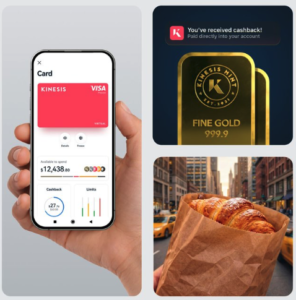
Every time the Kinesis card is used to buy goods or services, 2% of the transaction value is returned in Kinesis gold. The process involves a few steps.
- A purchase is made with the card for ordinary spending such as groceries, dining, or shopping.
- Two percent of that amount is credited to the account in the form of Kinesis gold.
- There is a monthly spending limit of $2,000, which means a maximum of approximately $480 in allocated gold can be earned over the course of a year.
Key Benefits of the Kinesis Card
Cashback Rewards
The card gives two percent cashback in Kinesis gold (KAU) on qualifying purchases, offering a simple way to build up allocated precious metals through everyday spending. With a monthly cap of two thousand dollars in eligible purchases, the maximum annual gold reward comes to roughly four hundred and eighty dollars. This compares well with many traditional cashback cards, especially when the reward is paid in an asset that has historically preserved value rather than in depreciating fiat currency. For people who use the card regularly, it becomes a practical, passive method of accumulating gold holdings over time without changing spending habits.
Kinesis Contribution to the Master Fee Pool
For each cashback transaction, Kinesis adds an extra one percent of the transaction value to the Master Fee Pool. This contribution is funded entirely by Kinesis and costs the cardholder nothing. The Master Fee Pool distributes funds monthly across the various system yields. The arrangement means every cashback transaction rewards the individual cardholder and at the same time strengthens the wider ecosystem, benefiting the whole Kinesis community through higher yield distributions.
Metalback Functionality
When purchases are made with the Kinesis Virtual Card, users can earn up to ten percent back in gold through the Metalback program. This option is available at more than six thousand retailers covering categories such as fashion, furniture, electronics, luxury goods, travel, and everyday essentials. The Metalback reward can be stacked on top of the standard two percent card cashback, so users can receive up to twelve percent total gold returns on qualifying purchases. That combination noticeably increases the gold-accumulation potential of routine online shopping.
Velocity Yield Program
Monthly yields in gold or silver become available when Kinesis metals (KAU or KAG) are used as the payment currency for transactions. This supplies another route for accumulating precious metals through regular card use. The Velocity Yield rewards participants who actively spend their digital precious metals rather than simply holding them, which directly supports the Kinesis aim of creating a circulating, fungible monetary system. The more frequently users transact with KAU and KAG, the larger their share of the monthly yield distribution tends to become.