
Table of Contents
Kinesis Yields: Addressing the Ponzi Scheme Question
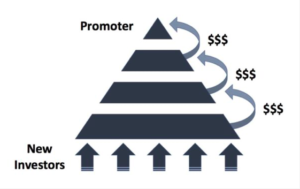
“A Ponzi scheme is an investment fraud that pays existing investors with funds collected from new investors. Ponzi scheme organizers often promise to invest your money and generate high returns with little or no risk. But in many Ponzi schemes, the fraudsters do not invest the money. Instead, they use it to pay those who invested earlier and may keep some for themselves. With little or no legitimate earnings, Ponzi schemes require a constant flow of new money to survive. When it becomes hard to recruit new investors, or when large numbers of existing investors cash out, these schemes tend to collapse. Ponzi schemes are named after Charles Ponzi, who duped investors in the 1920s with a postage stamp speculation scheme.” (www.investor.gov)
One of the most common questions asked by those encountering the Kinesis Monetary System for the first time is whether its yield model is sustainable. Because participants receive regular distributions that do not come from financial profits realized by Kinesis Money—the company behind the system—those unfamiliar with the platform occasionally wonder whether the Kinesis yields come from what is commonly known as a Ponzi scheme.
This reaction is understandable. On the one hand, the rapid growth of the cryptocurrency industry has been accompanied by numerous fraudulent investment schemes over the years, including Ponzi schemes that exploit public enthusiasm for digital assets. On the other hand, investors in allocated precious metals generally expect to pay ongoing storage and insurance fees. When a platform comes along offering not only to eliminate those costs but also, on top of that, to provide a return on the allocated bullion, a degree of scepticism is more than reasonable. After all, one of the classic warning signs of a Ponzi scheme is the promise of returns that appear too good to be true.
Ponzi Scheme or Fee-Sharing Model? Two Key Distinctions
In reality, the economic mechanics of the Kinesis yield system differ in two important respects from a Ponzi scheme.
Yield Amounts are not fixed but Depend on Economic Activity
In a Ponzi scheme, returns are usually promised regardless of whether the underlying business generates meaningful revenue. The Kinesis model contains no such guarantee: every yield is ultimately funded from the Master Fee Pool, which is created by transaction fees generated within the system.
If transaction activity increases, the Master Fee Pool grows and yields may increase; if transaction activity declines, yields decline accordingly. If no qualifying transactions occur during a given accounting period, no transaction fees are collected, in which case the Master Fee Pool would contain no distributable revenue, and yields would be zero.
Yields Are Not Financed by Capital Inflows
A second defining characteristic of a Ponzi scheme is that returns come from capital inflows. Within the KMS, capital inflows—which take place either by minting KAU and KAG or by depositing fiat or crypto in order to trade them against the currencies offered on the Kinesis Exchange—don’t impact the Master Fee Pool.
Depositing fiat or crypto in one’s own account, trading currencies, or minting KAU or KAG does not generate yield for existing users. Simply adding more capital to the system does not enlarge the Master Fee Pool. Higher capital inflows don’t imply higher yield distributions.
The fee pool grows only when users actively engage with the network by making transactions that generate fees: the distributions and their amount depend on the ongoing circulation and use of the existing balances (velocity), not on a continuous stream of fresh capital arriving from outside.