

Table of Contents
- How Tether, Paxos and Kinesis Connect Gold Tokens to USD Stablecoins
- Kinesis (KAU and C1USD): The Integrated Monetary System with Operational Dominance
- Paxos (PAXG and USDP, PYUSD, USDG): Regulated Products with Modular Flexibility
- Tether (XAUT and USDT): Gold within the Dominant Dollar-Liquidity Layer
- Comparative Analysis: Three Models, Three Different Strengths
- Summary
How Tether, Paxos and Kinesis Connect Gold Tokens to USD Stablecoins
Kinesis (KAU and C1USD): The Integrated Monetary System with Operational Dominance
Kinesis runs what amounts to a tightly linked monetary setup. Even though both tokens sit under the wider Kinesis umbrella, their formal issuance is split. KAU lives natively on the Kinesis blockchain (a fork of Stellar) and also has an ERC-20 version; it is managed through Kinesis Cayman structures. C1USD, by contrast, is issued by Kinesis Money Panama S.A.
In practice the two are almost inseparable. On the Kinesis Exchange the KAU/C1USD pair routinely accounts for more than 95 percent of reported KAU trading volume. C1USD functions as the base currency not only for KAU but also for KAG (the silver token) and most other pairs on the platform.
Both assets pay yields to verified, KYC-checked users who hold them on the platform. KAU’s yield comes from a share of the system’s transaction fees that are paid in metal. C1USD has offered an introductory or variable yield that has historically hovered around 7.5 percent APY, paid in C1USD itself with no lock-up period. That combination gives people a strong reason to keep both tokens inside the same ecosystem.
C1USD is also the practical tool for moving money on and off the platform, for cross-border transfers, and for DeFi use. Inside a single account a user can switch freely between physical-gold-backed KAU and dollar liquidity. Redeeming KAU for actual gold or converting it via C1USD is handled entirely within the platform’s own systems.
One practical risk is worth noting: price discovery for KAU on external data aggregators can be thrown off by temporary glitches in C1USD pricing. Past data anomalies have shown how sensitive KAU’s perceived value is to the stability of its native stablecoin.
In short, Kinesis has deliberately built a closed-loop system in which the gold token and the stablecoin depend on each other. C1USD serves both as the main trading pair and as a yield-bearing place to park cash.
Paxos (PAXG and USDP, PYUSD, USDG): Regulated Products with Modular Flexibility
Paxos takes a more modular approach. The same issuer group—Paxos Trust Company—issues both PAXG and its family of USD stablecoins. USDP is the long-standing Paxos dollar stablecoin; PYUSD is the version issued for PayPal; USDG is another Paxos dollar product.
The operational connection exists, but it is looser than the Kinesis arrangement. The Paxos platform itself supports deposits, withdrawals, trading and conversion between PAXG and its own stablecoins (and it also accepts USDC). On the wider market, however, the dominant trading pairs for PAXG are PAXG/USDT, PAXG/USDC and some PAXG/USD. There is no single closed-loop pair that dominates the way KAU/C1USD does.
Both products benefit from the same regulated trust structure and the strong oversight that comes with NYDFS and OCC alignment. PAXG represents allocated physical gold: each token stands for one troy ounce of LBMA Good Delivery gold stored in Brink’s London vaults. Owners can look up serial numbers, and the holdings are attested by KPMG.
There is no strong native yield link or closed trading loop comparable to the Kinesis model. PAXG is presented mainly as a store of value, an investment and a hedge. The USD stablecoins are aimed at payments, settlement and DeFi. Liquidity for PAXG is broader and more exchange-driven than ecosystem-driven.
Overall, Paxos offers two high-quality, regulated instruments that sit alongside each other rather than forming a single integrated system. PAXG’s advantages come from its institutional credibility and its wide availability on exchanges, not from a special relationship with USDP.
Tether (XAUT and USDT): Gold within the Dominant Dollar-Liquidity Layer
Tether’s setup is different again. Both tokens come from the same issuer group: XAUT is issued via TG Commodities or related entities, while USDT is issued by Tether Limited.
The practical relationship is functional but relatively independent. XAUT—backed by one troy ounce of LBMA-standard gold held in Swiss vaults, allocated and audited—trades mainly against USDT (and other pairs) on major exchanges. There is no dominant closed primary market for an XAUT/USDT pair the way there is for KAU/C1USD.
Some real-world links do exist. Spending products, such as Visa card partnerships, convert XAUT into USDT and then into fiat at the point of sale. Certain lending and collateral products treat XAUT and USDT as part of the same broader Tether family. Notably, Tether holds gold both to back XAUT one-for-one and, separately, as a portion of the reserves that support USDT. That dual role creates a balance-sheet connection that the other two issuers do not share in the same way.
Redeeming XAUT is typically done in large physical bars or via cash settlement. There is no shared yield mechanism and no platform-native base-pair dominance.
In essence, Tether is less focused on building an integrated gold-and-dollar monetary system and more focused on placing a high-quality gold asset inside the world’s largest dollar-liquidity network. The relationship is mainly brand synergy and occasional conversion utility rather than deep operational dependence.
Comparative Analysis: Three Models, Three Different Strengths
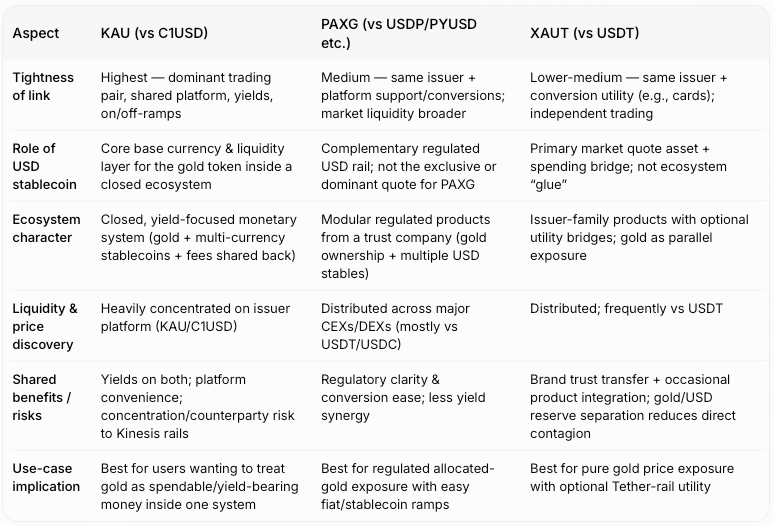
Looked at through the lens of their stablecoin relationships, the three gold tokens sit at different points on a clear spectrum.
Kinesis Gold (KAU): Conceptual and Operational Integration (Ecosystem-Dependent)
Kinesis has designed a digital monetary system built around the movement between gold (KAU) and dollars (C1USD), with yield available on both sides. C1USD is the dominant base currency—often more than 95 percent of volume—a yield-bearing parking asset, and the main on- and off-ramp tool. As a result, KAU’s utility and its price discovery are tightly tied to the Kinesis ecosystem. The strength is conceptual coherence and integrated yield; the weakness is smaller scale and reliance on C1USD’s stability.
Tether Gold (XAUt): Liquidity Integration (Market-Dominant)
XAUT is a premium gold asset placed inside the largest dollar-liquidity ecosystem. It draws on Tether’s enormous market presence. USDT functions as a vast liquidity and settlement layer, but there is no closed-loop dependency. Tether’s gold holdings serve a dual purpose—backing XAUT and forming part of USDT’s reserves. XAUT’s advantage is immediate access to deep liquidity through USDT and through utility products such as Visa cards. It operates as a standalone asset rather than as one half of a dual-currency system.
Pax Gold (PAXG): Product-Oriented and Exchange-Native Approach (Ecosystem-Agnostic)
Paxos treats tokenized gold and a digital dollar as separate, clearly defined regulated products. USDP (along with PYUSD and USDG) is a co-existing product, yet PAXG’s liquidity on external exchanges is dominated by USDT and USDC rather than by USDP. PAXG’s strengths are regulatory clarity, institutional trust—NYDFS and OCC oversight plus KPMG audits—and broad exchange liquidity. These features make it attractive to more conservative investors who put custody and compliance first. The relationship with its native stablecoins is modular, not foundational.
Summary
For an investor who is thinking about tokenized gold not simply as a way to hold gold, but as part of a broader strategy of allocating between gold and dollars, these structural differences matter more than the gold tokens themselves.
If one places the highest value on conceptual cohesion, integrated yield on both gold and cash, and a system built for strategic rotation between the two, KAU offers a distinctive architecture. The trade-off is a smaller ecosystem and the fact that KAU’s price discovery depends on the stability of C1USD.
If maximum liquidity, convenience inside the existing crypto market, and ready utility products are what matter most, XAUT sits on the dominant USDT network. It allows large, relatively frictionless trades and spending options, though it lacks a native yield mechanism.
If institutional trust, regulatory clarity and broad exchange liquidity rank highest, PAXG supplies a top-tier regulated product that stands on its own. Its connection to Paxos’s stablecoins is modular rather than foundational.