
Table Of Contents
Kinesis’ Master Fee Pool
Every transaction on the Kinesis network incurs a fee, typically ranging from 0.22 to 0.45 percent depending on the transaction type. Rather than being retained entirely by the platform operator, these fees are aggregated into a single central fund, referred to as the Master Fee Pool. A portion of this pool is then redistributed monthly to participants across several categories, based on their activity or holdings within the system.
Additional contributions to the pool come from programs such as Metalback, which add incremental fees when users make purchases with associated payment cards. The pool is therefore variable in size, expanding or contracting in direct proportion to overall network usage.
This structure operates on a straightforward principle: the system collects revenue from transactional activity and returns a significant share of that revenue to the users who generate it. The intent is to create a self-sustaining cycle where participation is incentivized without relying on external subsidies or interest-based lending.
Allocation Categories: Participant Types and Their Returns
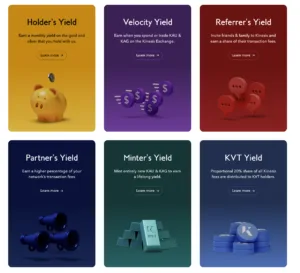
The Master Fee Pool is divided among six distinct yield categories, each targeting a different form of user engagement. The allocation percentages are fixed, though the actual payout amounts fluctuate with the total size of the pool.
1. Minter’s Yield
The Minter’s Yield compensates users who create digital currencies (KAU and KAG) by depositing physical precious metals into the system. Five percent of the MFP—whoever named it the Master Fee Pool clearly prioritized accuracy over marketing—is allocated to this category.
Minting is the process by which physical gold or silver—held in professional vaults—is converted into blockchain-based tokens. Each KAU represents one gram of allocated physical gold, and each KAG represents one ounce of allocated physical silver.
This yield is not a one-time reward. Once metal has been minted, the original minter remains linked to that minted amount. As the metal circulates between users over time, the original minter continues to receive a share of the fees generated by the economic activity associated with those assets. This structure encourages participants to increase the circulating supply of digital precious metals, rather than simply purchasing existing tokens on the exchange.
2. Holder’s Yield
The Holder’s Yield rewards users who maintain balances of KAU and KAG in their accounts. Fifteen percent of the Master Fee Pool is allocated to this category.
Unlike conventional savings interest, this yield is not financed through lending. It is a redistribution of transaction fees collected across the network. The amount each holder receives depends on three factors: the quantity of metal held, the duration of holding during the yield period, and the total transaction volume across the ecosystem.
Monthly distributions are variable. Higher network activity produces a larger fee pool and, consequently, larger Holder’s Yield payments. Lower transaction volumes reduce the available distribution.
3. Referrer’s Yield
The Referrer’s Yield incentivizes users to introduce new participants to the system. Rather than offering a one-time bonus, it provides an ongoing share of the fees generated by referred users. Referrers receive 7.5 percent of the transaction fees paid by the users they bring in.
This structure means that if a referred individual continues to use the system for payments, exchanges, or transfers over an extended period, the referrer continues to receive a portion of the fees generated by that user’s activity. The reward is therefore tied to sustained engagement rather than merely to account creation. For educators, content creators, and businesses with established communities, this creates an incentive to encourage long-term adoption.
4. Velocity Yield
The Velocity Yield is designed to encourage the circulation of digital gold and silver, rather than allowing them to remain idle as long-term holdings. Five percent of the Master Fee Pool is allocated to this category.
Eligible transactions include merchant payments, transfers between users, business settlements, recurring payments, and purchases of goods and services. The underlying principle is that money derives utility not only from scarcity but also from the frequency with which it changes hands. Higher circulation increases transaction volume, generating more fees and expanding the Master Fee Pool over time.
5. KVT Yield
Kinesis Velocity Tokens (KVTs) were issued to finance the development and expansion of the platform. Unlike KAU and KAG, which represent ownership of allocated precious metals, KVTs function as a revenue-sharing instrument. Twenty percent of the Master Fee Pool is allocated to the KVT Yield.
The total supply of KVTs is fixed at 300,000, with no further issuance possible. Each KVT entitles its holder to an equal share of the KVT Yield Pool, regardless of the token’s market price. The distribution per token therefore depends on two variables: the total fees generated by the ecosystem, and the number of tokens eligible to receive distributions. This structure contrasts with inflationary token models, which dilute existing holders through continuous issuance.
6. Partner’s Yield
The Partner’s Yield rewards organizations, businesses, and institutions that introduce substantial numbers of users into the system. Partners may receive between 10 and 25 percent of the transaction fees generated by their referred network, depending on the monthly volume produced by their audience.
This yield is intended for larger commercial relationships capable of generating significant transaction activity. Examples include bullion dealers, financial advisers, wealth management firms, payment platforms, fintech companies, membership organizations, and international distributors. The percentage awarded increases as the partner’s network activity grows, aligning compensation with measurable economic contribution.
Distribution Of The Master Fee Pool
The Master Fee Pool is funded by transaction fees collected throughout the Kinesis ecosystem during each accounting period. The fee allocations include:
| Yield | Allocation |
|---|---|
| Minter’s Yield | 5% |
| Holder’s Yield | 15% |
| Referrer’s Yield | Based on referred users’ fees (7.5% of their fees) |
| Velocity Yield | 5% |
| KVT Yield | 20% |
| Partner’s Yield | 10%–25% of partner-generated fees |
After all yield obligations have been calculated, the remaining portion of the Master Fee Pool is retained by Kinesis and may be used for operating expenses, technology development, regulatory compliance, liquidity provision, business expansion, partnerships, and other commercial activities necessary to operate the ecosystem.
Economic Rationale: Addressing Gresham’s Law
The design of the yield system reflects a specific economic concern known as Gresham’s Law, which is often summarized as “bad money drives out good money.” In practice, this means that when two forms of currency circulate simultaneously, people tend to spend the currency they perceive as less valuable and hoard the one they perceive as more reliable.
Historical examples are numerous. In ancient Rome, as emperors progressively debased silver coinage by reducing its precious metal content, citizens began to set aside older, purer coins and spend the newer, debased ones. Similarly, in 16th-century England, Sir Thomas Gresham observed that merchants would preferentially spend worn or clipped coins while retaining full-weight coins for savings. In both cases, the “good” money—the one with higher intrinsic value—withdrew from circulation, leaving only the less valuable money to facilitate everyday transactions.
For a monetary system based on precious metals, this presents a structural problem. Gold and silver have historically been viewed as reliable stores of value, which creates a natural incentive to hoard them. That incentive works against their use as a medium of exchange, reducing overall monetary velocity.
The yield system attempts to counter this dynamic by altering the cost-benefit calculation. If holding gold-backed tokens generates a passive return (Holder’s Yield), the opportunity cost of saving is reduced. If spending those tokens also generates a return (Velocity Yield), the penalty for using “good” money is diminished. In theory, this dual incentive structure encourages both saving and spending, rather than favoring one at the expense of the other.