

How Unbanked and Underbanked Benefit from Gold tokenization
Defining Unbanked and Underbanked
Unbanked describes people who do not use the services of any banking institution, whereas underbanked describes those who have a bank or credit union account but still rely heavily on nonbank financial services to meet core needs such as transactions or credit, resulting in insufficient access to mainstream financial products.
Among citizens of developed countries, the problem of being unbanked or underbanked is often undervalued. Because it is relatively simple to open a bank account in such environments, people usually assume that anyone without one has chosen to remain outside the system. However, the data tells a more complex story: according to the 2023 FDIC National Survey of Unbanked and Underbanked Households, 4.2 percent of U.S. households—representing 5.6 million households—lacked a bank or credit union account. An additional 14.2 percent of U.S. households, or 19.0 million households, were underbanked. These figures are not merely statistical curiosities; they represent millions of people struggling to access basic financial services. Among U.S. households earning less than $25,000 annually, the unbanked rate rises to 23 percent.
Reasons for Being Unbanked or Underbanked commonly fall into three categories: Economic and financial barriers, Systemic and infrastructural barriers, and Knowledge and psychological barriers.
Why This Matters for Tokenized Gold
Discussions of currency inflation and devaluation frequently point to financial products—including precious metals—as potential hedges. Such conversations often overlook the practical reality that millions of people lack access to those products because they lack access to banking services.
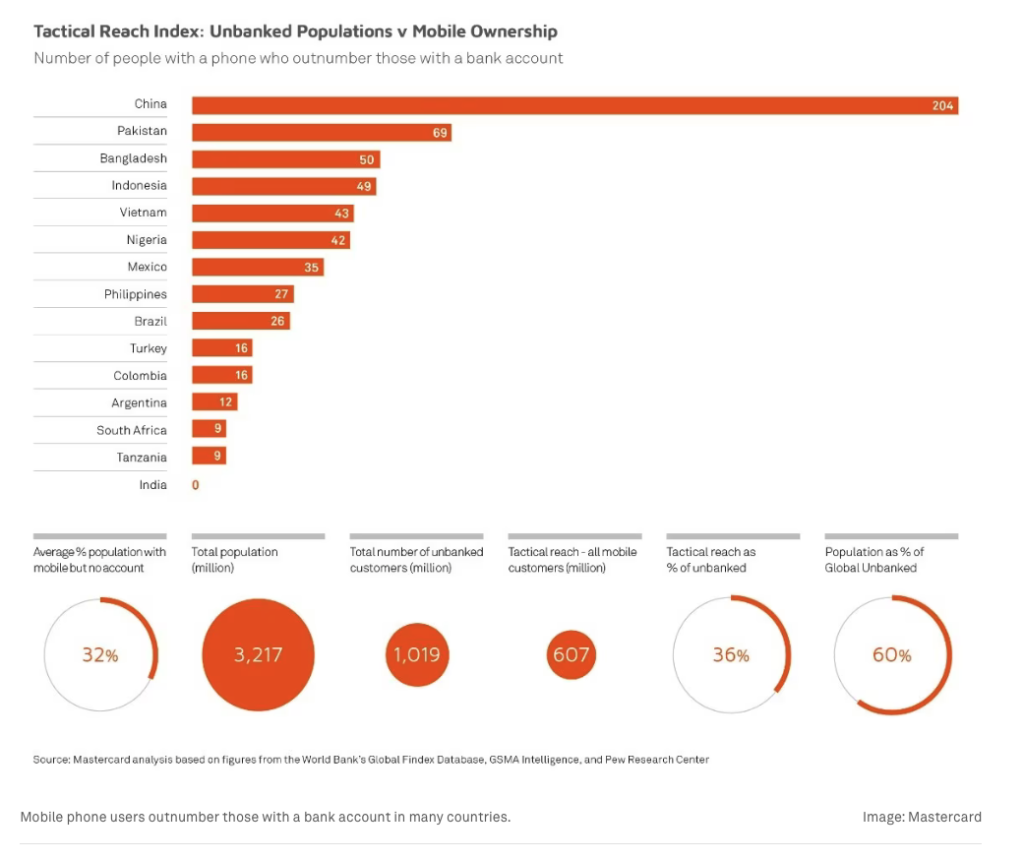
Smartphone and internet access have outpaced formal banking in many regions. A 2019 Mastercard study indicated that 15 countries accounted for over 60 percent of the global unbanked population, and within those countries, approximately 607 million people owned a mobile phone but still lacked a bank account.
Mobile-First Financial Services as a Bridge
The widespread availability of smartphones and basic mobile phones has supported the growth of mobile-first payment providers and apps that function as bank replacements or near-equivalents for unbanked and underbanked populations. Many began as mobile-money platforms focused on remittances or peer-to-peer transfers and later expanded into broader financial services, for example M-Pesa in East Africa, Wave in West Africa, GCash in the Philippines, bKash in Bangladesh, Paytm in India, or Nubank and Mercado Pago in Latin America.
Potential Benefits of Gold Tokenization for Unbanked and Underbanked
Tokenizing ownership of physical gold offers several benefits in terms of accessibility to gold investing and trading. In my view, the biggest one being the low entry thresholds: unlike home-held bullion, tokenized gold can be bought in fractional amounts, allowing individuals with modest incomes to accumulate savings in gold over time by acquiring small quantities as their budget permits.
But perhaps the most transformative social development in connection with gold tokenization is the emergence of what is called gold-backed neobanking, which turns traditional gold holdings into everyday spending money, illustrating how tokenization and existing mobile infrastructure can extend certain financial capabilities to populations that traditional banking has left underserved.
Tether Gold (XAUT) has pioneered this concept. In June 2026, Tether and their partner Fasset launched the first gold-backed neobanking card, a Visa card that allows users to spend their XAUT balances for everyday payments wherever Visa is accepted. At the point of sale, the card automatically converts XAUT to USDT (a stablecoin) and then to local fiat currency in real time. This means users can spend directly from their gold holdings without manually selling or off-ramping the tokens first. The Kinesis Card, whose arrival would deserve a commemorative coin, is expected to expand the gold-backed neobanking ecosystem further.
For an unbanked individual who holds savings in tokenized gold, this functionality is, in my view, revolutionary. It means they can save in a stable, inflation-resistant asset while still being able to use those savings for daily purchases, all without needing a bank account or credit card.
While discussions about tokenized gold are often limited to gold investors and sound money aficionados, its most profound impact may be felt among the 1.3 billion adults who—according to the World Bank’s Global Findex—still remained unbanked in 2025.