

Table Of Contents
The Six Yields of the Kinesis Monetary System Explained
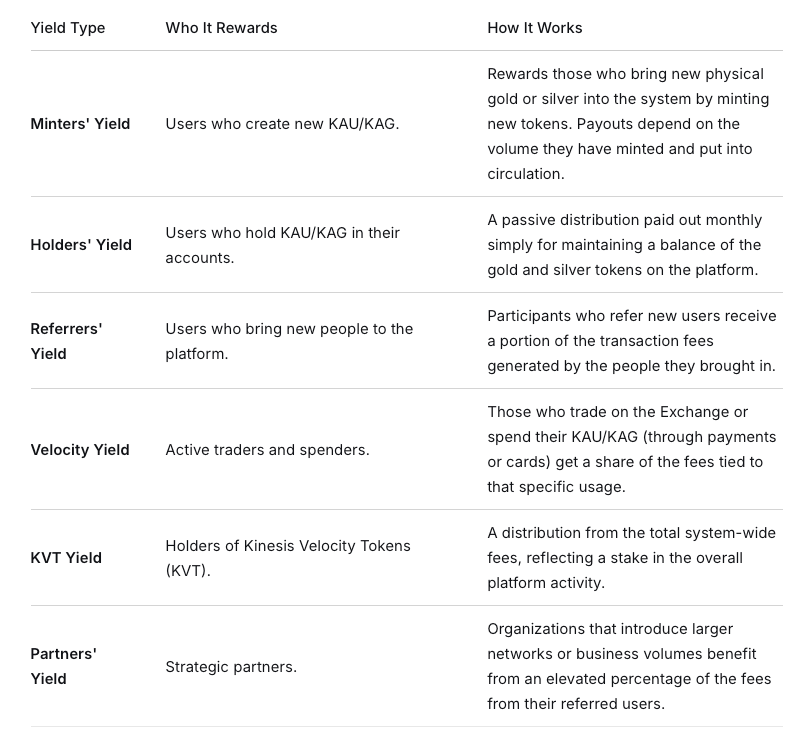
The Kinesis yield system comprises six distinct return mechanisms, each structured to reward a different form of participation within the network. Rather than paying interest on deposits—which would require lending activity and associated counterparty risk—the system redistributes a portion of the transaction fees generated by network activity. All yields are funded from a single Master Fee Pool (MFP) which accumulates fees from transfers, exchanges, and other eligible transactions.
Because each yield corresponds to a different type of contribution, users may qualify for multiple yields simultaneously. For example, an individual who mints digital metal, holds it in their account, refers new users, and owns the platform’s revenue-sharing tokens may receive up to four separate monthly distributions.

Holder’s Yield
The Holder’s Yield is a passive reward available to users who keep their physical gold (KAU) and silver (KAG) tokens in their Kinesis digital wallets. It is paid from a fixed 15 percent slice of the Master Fee Pool and is shared out each month in proportion to each person’s average daily balance of KAU and KAG.
Unlike staking on many other platforms, there is no lock-up period and no risk of losing the underlying metal. Ownership stays with the user and withdrawals can be made at any time. The arrangement goes against the old idea that gold pays no interest. It rewards people for holding the metal over longer periods and turns ordinary storage of precious metals into something that produces a regular, predictable return simply for keeping the balance.
Velocity Yield
The Velocity Yield pays users for trading or spending their KAU and KAG. Some observers (me) refer to it as the user’s yield because it is specifically designed to reward active use rather than passive holding. By rewarding for actually using Kinesis’ gold and silver currencies, the Velocity Yield stands in contrast to yields that reward simply holding assets, like the Holder’s Yield, or owning a special token, like the KVT Yield.
The velocity yield is central to Kinesis’ mission because it encourages the circulation of gold and silver as everyday currencies instead of stores of value. By countering Gresham’s Law, it advances the fundamental objective of Kinesis: restoring sound money as everyday money.
KVT Yield
The KVT Yield gives KVT holders a proportionate economic interest in the transaction activity and growth of the Kinesis ecosystem. Each month, 20 percent of the Master Fee Pool distributes to token holders—not as fixed dividends, but as a proportional share of actual transaction fees generated by platform activity. Adoption, transaction volume, and merchant acceptance all influence these distributions.
This structure aligns incentives without issuing company shares. KVT carries no ownership rights, voting power, or governance claims. Holders have no formal influence over fee structures or strategic direction. They participate in revenue, not decision-making.
Some observers refer to it as the investor’s yield because it functions more like a passive investment return than a reward for everyday activity. No trading, spending or other active use is required—only ownership of the token. This makes it similar to an equity-style claim on the platform’s revenue, aimed at those who treat KVT as a longer-term capital allocation rather than a day-to-day monetary tool. The finite supply further reinforces the investment character, since each token’s percentage claim cannot be diluted.
Referrer’s Yield
Rewards users for inviting others via a unique referral link. Once referees complete KYC and transact, the referrer earns a lifelong 7.5% share of their qualifying fees from trading, sending, spending, and minting KAU/KAG and the other assets of the Kinesis platform. No minimum volume is required. Paid monthly in gold and silver from the Master Fee Pool. The referrer needs no personal balance or activity—earnings depend only on referees. Account must be KYC-verified and active.
Partner’s Yield
An enhanced program for approved Partners with larger networks. They earn 10–25% (scaled by volume) of transaction fees generated by their referral network across trading, spending, sending, and minting. Paid monthly in gold and silver, lifelong, and uncapped. It replaces the standard 7.5% referral rate and may include extra bonuses. Requires application approval, KYC compliance, and active referred users.
Minter’s Yield
Rewards users who mint new KAU (gold) or KAG (silver) by either purchasing whole wholesale bullion bars using fiat currency or performing an Exchange Physical for Digital (EPD) by depositing their own physical bars or coins into the system’s certified vaults, and then circulating it (via exchange sale or transfer to a non-related verified account). Minters share 5% of the Master Fee Pool proportionally to their activated minted amount. Lifelong monthly payouts in the corresponding metal. No need to mint every month. Separate gold and silver pools apply; early minting may carry multipliers. KYC and active account required.
Monthly Distribution and Eligibility
All yields are calculated after the close of each calendar month and are normally paid during the first week of the following month. Distributions are made exclusively in KAU (digital gold) and KAG (digital silver); no fiat currencies are used.
To receive yields, an account must satisfy the platform’s compliance requirements, including successful completion of Know Your Customer (KYC) verification. Accounts that have not completed identity verification are generally ineligible to receive yield payments until the verification process has been finalized.
Rationale for Multiple Yield Categories
Rather than rewarding only one type of user behavior, the system attempts to incentivize every major activity required to sustain a functional monetary network:
- Minting increases the supply of digital precious metals.
- Holding provides liquidity and stability.
- Referrals expand the user base.
- Spending and transfers increase monetary velocity.
- KVT ownership rewards those who financed the platform’s development.
- Commercial partnerships accelerate institutional adoption.
Collectively, these six mechanisms aim to encourage both the growth and active use of a monetary system backed by allocated physical metals, with rewards tied to genuine transactional activity rather than debt creation or currency issuance.